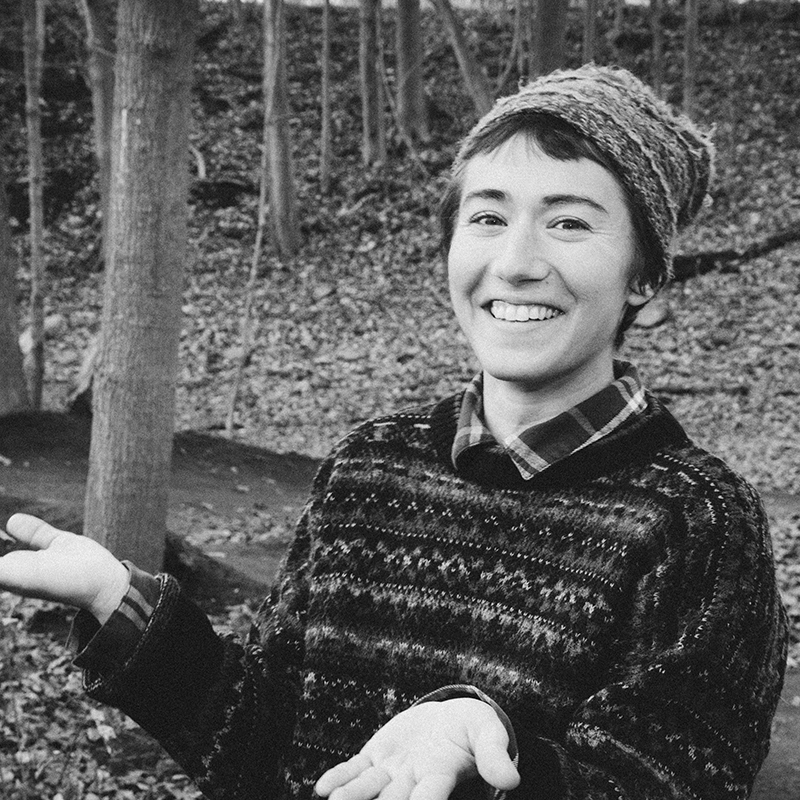
Interviewee: Corey Laitman, Turners Fall, MA
Interviewed by Tabita Doujad, Amherst, MA
Date: October 3, 2020, Via Zoom
Topic: The Arts and Creativity During COVID19
Tabita Doujad: This is Tabita Doujad. Today is October 3rd, 2020, and I am interviewing Corey Laitman for the Hampshire College COVID-19 Oral History Archive. This interview is taking place over Zoom. This interview is sponsored by Hampshire College, and it’s part of the first-year seminar, Pandemics. So I have a couple of introductory questions, and then we can get into the main questions.
Corey Laitman: Okay.
TD: So, Corey, where are you located right now?
CL: I’m currently located in Turners Falls, or Great Falls. [Montague, MA.]
TD: I need to ask for your permission to record and include your interview, both audio and visual formats, in the Hampshire College COVID-19 Oral History Archive.
CL: Mhm.
TD: Is that okay with you?
CL: Yeah. You just need my verbal permission?
TD: Yeah, just to say yeah.
CL: Yeah, I give you my verbal permission to use this interview however it pleases you.
TD: Amazing. And I will also be sending you a consent/release form for you to sign.
CL: Sure.
TD: So what year were you born, Corey?
CL: In 1988.
TD: And where are you from?
CL: I’m from Westchester County, New York. I grew up in a town called Bedford.
TD: And what is your occupation?
CL: Well, right now, I think my occupation/vocation is that I’m a musician, but for money, I am driving CSA shares around for a farm called Just Roots. So I’m a truck driver right now.
TD: So cool.
CL: It’s pretty amazing.
TD: And how many years have you spent as a musician?
CL: Oh, jeez. Well, publicly-slash-professionally, probably around a decade at this point, maybe just shy of a decade.
TD: Will you tell me about your life as a musician?
CL: Sure. Well, so I’ll start by saying that I was always scribing like little tiny songs when I was a kid, and did a lot of kind of collaborative projects when I was in high school, where people would write poems and have me set them to music, so that was the beginning of my love of lyrics, and words, and expressive poetry. And then I moved to New York- New York City- and was part of a scene, like a group of people, a community called the Anti-Folk community, who were located, or based, out of this bar called the Sidewalk Cafe, in the East Village, and it was very multigenerational, very experimental, very weird, and I feel like that’s where I came of age as a musician, and really started to understand what I wanted from being a musician, or that part of what I wanted from being a musician was to be in community with other musicians.
And it was in New York that I put out my first album, which is called Grimace and Grace. It was produced by Peter Hochstedler, who is a beautiful musician in his own right. I don’t know how long- I could say a lot about this, but for the past couple of years I’ve been playing and writing in Western Massachusetts.
TD: So, Corey, do you sing?
CL: I do sing. I do sing, yeah.
TD: What do you like to sing? How would you talk about your voice?
CL: Wow, that’s a great question. I feel like my voice is kind of like an indicator, like the canary in my own coal mine of a body, you know? Like, when I am feeling really tense and exhausted, my voice- my singing voice- feels really reluctant to be issued from my body. And when I’m feeling really expansive, and safe, it’s just like the most playful thing about me, I think. You know? And it’s always been the most reliable way I’ve had since I was very small to soothe myself. And to drop into the quiet, most tender space in me.
TD: I love that so much.
CL: It’s a great question, that was one of your questions.
TD: Well, I love your answer. Wow. So, the last introductory question is, before COVID, did you have audiences? Or: did you perform? And who were your audiences?
CL: Mmm. I did have audiences, and I did perform. I performed a lot around Western Mass. I performed regularly at this place called Luthiers Co-op, in Easthampton, and at a place called Club Passim, in Boston, which is this historic folk venue. And I was actually, right before the pandemic, being managed by someone who was sending me to far-flung places to open for more established acts with the hope of my getting a foot in the door, and it was really exciting and also really exhausting, and I realized that I did not want to be traveling that much. And also, he was a confusing person: he was a lawyer, and a Zionist, and also owned Elektra Records for a while, and, anyway, I digress. But I think my audiences are pretty diverse, but they consist of people who, um, I think people who want a vehicle to feel their feelings. And are interested in being in conversation about how to feel their feelings.
TD: How has the pandemic affected you as a creative person?
CL: So before the pandemic, I was extremely strung out. I was traveling all the time and I was also working and I was also getting a master’s degree in interdisciplinary arts, which was such a- it was both a- it was a profound experience and it was also a total shitshow. And I felt like a total shitshow. My nervous system was just frayed constantly and I felt like I had no real creative bandwidth, and in the weeks and months preceding the pandemic I had been planning this, like, big tour, and this big Kickstarter campaign, and I was doing all this very public-facing stuff, or outward-facing stuff. And then the pandemic hit, and I had to cancel everything. And I was very shy, or, timid about admitting this for a while, but I felt- it was a complicated gratitude, but I felt so, so grateful. To just have my life reduced to this very small, very contained thing. Because I had to just shed a lot of clutter, and I have been more creative in these past eight months than I have probably in years. Just because I feel like I am situated inside of my own life in a way that feels manageable to me, for the first time in a long time. The strange blessings of COVID.
TD: Before the pandemic, how might you have defined success as a musician? [(Inaudibly:) And has that changed?]
CL: Yeah. That’s a great follow-up question. Well, I think before the pandemic, I had reached this point in my career where I had the things that I thought I wanted. You know, I went to this music conference and this really influential, gate-keeper person saw me and wanted to manage me for free, and he was getting me on all these radio stations, and I had a couple of mentions on NPR, but what I discovered was that more often than not fame is bought, and success in the music industry is a capitalist endeavor, and I was so disgusted by the business aspect of it, and by all of the self-promotion I was having to do, and I felt really constrained by the kind of aesthetic that my manager was asking me to perform, and I hated it. It sucked so much. I had what I thought I wanted, and it was so bad, Tabita. It was so bad. And so now I’m realizing that I will always want to make music, and I will always want to share my music, but it will always be on my own terms. I don’t want to be managed by someone else. If someone else wants to support my creative vision, awesome. But I thought that I wanted to walk that more conventional path toward visibility, and it was a hard revelation to discover that I actually don’t. And also it was such a blessing to have gotten there, you know, and to have been given the opportunity to realize that that was not what I wanted. Because that easily could not have happened and I could have kept striving indefinitely.
TD: So have you been able to perform during the pandemic? And how has that expression of creativity changed since the pandemic has happened?
CL: Well, I’ve done some virtual shows. I did a virtual show through Passim, which was actually really lovely- I don’t know if you’ve attended any virtual shows, but it’s cute, you know, like I’m the only one on the main screen, and then there’s this chat bar to the side of the screen and people can comment in real-time, and every time someone clicks on, like, a heart emoji, there are these hearts that float up through the screen, and there are just some cute things about the interface that I really liked and thought were sweet, and also, there was something about not having to cope with applause. That was such a relief to me, and, yeah, there was something about knowing that I was going to be listened to without interruption the whole time. And there’s something, too, about attending to all the faces in an audience while I’m playing that is actually quite distracting for me. That’s an edge that I want to lean into, but before the pandemic I was just feeling so raw and exposed that it was difficult for me to attend to faces, about which I’m pretty hyper-vigilant, while also staying contained enough and with my body enough to perform.
But yeah, I haven’t done too many of those shows. Mostly, I’ve been doing this- you might have seen this on my Instagram, but I’ve been doing this trade, this song trade, with this kid who I had creatively mentored before the pandemic. He’s eight. He’ll be nine soon- he’s a Virgo, so he’ll be nine soon- but he’s this genius songwriter. His name is Louis Phipps. And his dad reached out to me at the beginning of the pandemic, to [say], you know, hey, let’s all get together virtually, let’s stay connected, and we started this trade where we write songs to prompts, weekly. And it’s just been the most generative, amazing- I’ve written so many songs that I really, really like. And Louis’ written a lot of songs that I really, really like.
TD: Wow. That is so cool.
CL: Yeah. It’s wild. It’s so wild. I have a performance coming up, too, in October, that’s virtual, that I feel good about. It’s organized- it’s like a very queer, radical, curation of a show.
TD: Wow, so how have you connected with your audiences since the pandemic? Because you said it’s been different, and you’ve seen the little hearts going up in your virtual shows, but there’s that element of no audience faces. How do you connect with your audiences now?
CL: Well, social media has been huge, huge, huge. It’s been primarily social media. And there was a whole chunk of time where I put creatively interfacing with people through social media on the total back burner and that was the time in the immediate aftermath of the George Floyd protests. I was like, okay. I need to step way, way back from having any kind of voice in this space, in the interest of elevating other voices. And I think that was the right response in the moment, that felt like an appropriate response, and now I’m trying to discern a balance between not taking up too much space, but doing my job, and connecting with my audiences, and feeding myself creatively in that way. Yeah. That feels like a conversation that’s still very alive for me.
TD: That’s really beautiful. When you write songs now, what topics do you gravitate towards? What do you find yourself writing about?
CL: So, this is an interesting question for me, because most of what I’ve been writing has been a product of this prompt exercise with Louis. So, yeah, there’s so much magic in it for me. So, you know, he’s an eight-year-old boy- at least I think he’s a boy, I think he currently identifies as a boy- and he will come up with these lists that include like bluebirds, and fire, and baseball, and garbage, and whistling, and, you know, he’s a very poetically constituted kid. He’s always writing poems, and songs. He’s just a prolifically creative kid. But anyway, he’ll come up with these lists of prompts. And I’ll pick one. And I was thinking about this the other week: these prompts have been like little vessels that I can just pour my experience into. And it’s been so grounding to not be in a position where, in order to write a song, I just have to sit down with the chaos of my feelings, and, like, consider everything in the world. I really feel like I’ve been so overwhelmed, and I wouldn’t- I still, when I sit down to write a song without a prompt I just, like, don’t know where I am or what to do, because the chaos is such a din, and so difficult to organize, but it’s so beautiful to just have a word, and to just meditate on the word, and for months I’ve had this quote by Winston Douglas up on my wall that says- Oh, crap, it’s on my other wall, but I want to get the phrasing right, but I’m not going to. It’s something like, “I just write out my life”. Or, “I just sing out my life”. And that’s so grounding to me, I’m like, okay. Whistling. What is it? And then I look around, and kind of take stock of my life, and it’s been so useful for me to have, like, those edges to push up against, and I feel like without those edges, I would just have drowned, you know? So I’ve written a song about whistling, fire, marathons, bluebirds, bicycles. And I feel like the melancholy, and the overwhelm, and the tenderness, all get expressed, but they get expressed safely, you know, in a way that doesn’t feel like they’re trying to say something they’re not quite ready to say. Does that make sense?
TD: Yes, that makes sense.
CL: Of course that makes sense to you.
TD: Especially in this context, of the hard things happening, right, it would be different to write- I don’t know, I’m wondering how you feel. I feel like if I were to sit down and write a poem, right now, it wouldn’t be specifically, like, saying Oh, the pandemic is really hard. It would be about, maybe, a bluebird. And the bluebird would say it for me. In a different way. In a tender way.
CL: Beautiful. Yes.
TD: But I think- is that kind of how it might work for you, sometimes, if you were to express those things?
CL: Yeah. That’s gorgeous, yes. That’s exactly what I mean. Yeah. I write about whistling and the whistling says it for me. So fascinating, this conversation.
TD: So, I guess I was wondering about your plans and dreams, because I always wonder those things, and I was wondering, like, what were your plans and dreams before the pandemic? Or, you already kind of answered this. You know what I think I’m just wondering, is what do you dream about doing with your music now, from the place that you stand in these times?
CL: What do I dream about doing? So, really concretely, I dream about writing songs that are beautiful, and feel like gifts, collaborating with my friend Anand, and making them into these experiences, these kind of, like, larger experiences, and giving them away. To whoever wants them. And I think that there’s a way in this moment that I want to prioritize being accountable to myself, you know? Like I want these songs to be- I don’t wanna write songs with an audience in mind, which I think I was trying to do a little bit before the pandemic But I guess my dream is to just like, be able to express and have an audience, and make pretty things, and give them to people.
TD: Yes, amazing. That is so good. Is there anything that you wanted to tell me, or talk about, for the interview, that we’ve skimmed over? And of course, I can stay on the line, we can chat after. But I’m wondering if there’s anything for, like, people in the future that are thinking about this time- I don’t know, is there anything that you would want to say?
CL: Yeah. Well, I think something that’s been really helpful for me that I’ve discovered through my creative practice during the course of the pandemic has been the importance of just, like, grounding in simple reality, and present reality, in the midst of chaos. You know, and that’s a therapeutic technique that people use, like after a big emotional upheaval, it’s a therapeutic technique to be like, “can you name three red things around you”, you know? “Can you spell watermelon backwards”, you know? But I’ve just been thinking a lot recently and feeling the truth of how important presence is, I guess, and how important it is to practice presence, when the world is burning.
TD: That’s so beautiful. That is a beautiful note to end on. Gosh, thank you for this interview, Corey.
CL: Yeah. Absolutely. Thank you for interviewing me.
TD: Yeah.