
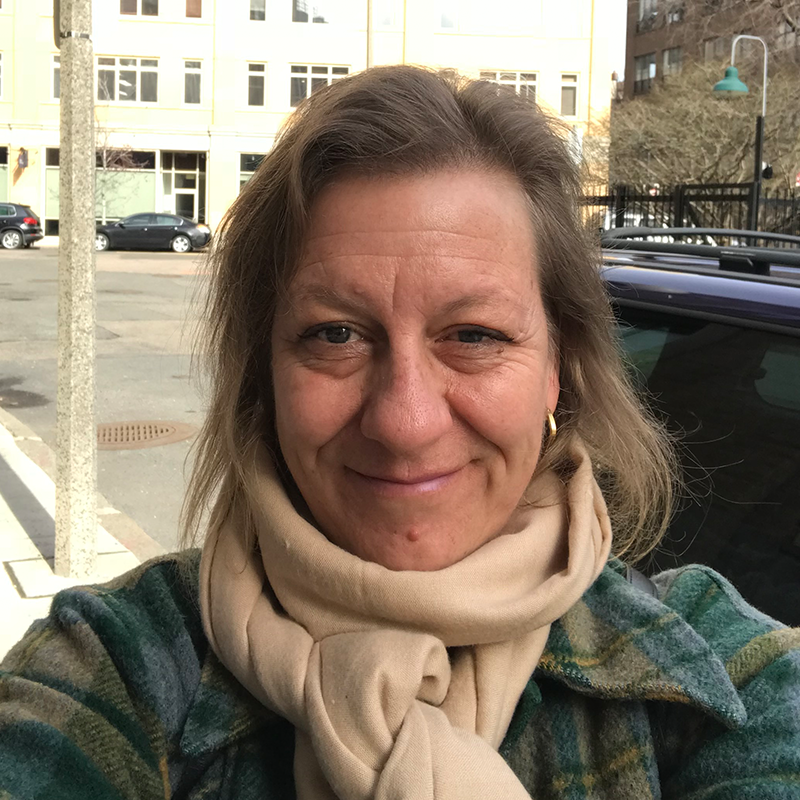
Interviewee: Stephanie Pernice, Lynnfield, MA
Interviewed by Jessica Liliedahl, Amherst, MA
Date: October 5, 2020, Via Zoom
Topic: Small Business Owners and the Pandemic
I’m Jessica Liliedahl. I’m currently in Amherst, Massachusetts, on Hampshire College campus. It is October 5th, 2020 and I am interviewing my aunt. Could you please introduce yourself?
Stephanie Pernice: Sure, hi. I’m Stephanie Pernice and I’m at my home in Lynnfield, Massachusetts.
Jessica Liliedahl (00:30): Awesome, thank you. I’m just going to ask for some verbal consent. Do I have permission to record this interview, visual and audio, and submit it to Hampshire College’s COVID-19 Oral History Archive?
Stephanie Pernice (00:45): Sure, of course.
Jessica Liliedahl (00:46): Awesome, thank you. So, I guess we’ll jump right into it! What do you do for a living?
Stephanie Pernice (00:55): Yeah! Of course. I have a nontraditional job. I run a flea market in Boston, and along with I source product for the flea market, which is attended by local people in Boston, college students, people visiting Boston, etc. So art, antiques, fashion, jewelry, objects, furniture, interesting items, music, LPs, etc. That is sort of a representation of the sort of products that you’ll find at the market that I work at.
Jessica Liliedahl (01:31): Awesome. How long have you been doing this for?
Stephanie Pernice (01:36): This is our eleventh year. So, eleven years. And prior to that, I guess I was sourcing, buying, and selling antiques for about ten years before that. Before I actually ran the market. So I guess I’ve been doing this twenty years. Have I been doing it that long? Not quite, that long Jess, sorry. Maybe like fifteen. Five years before the market.
Jessica Liliedahl (2:00): How has your business been since the pandemic started?
Stephanie Pernice (02:05): That’s an interesting, and layered question to answer. At first, our business was pretty much halted, because we chose to close our business, which brings together a lot of people. We chose to close our business at the beginning of the pandemic so that we wouldn’t create a hot spot. So, of course, that meant that our business was just stopped and we went to a live Instagram format. Which was okay, I mean, I would say that we did, we realized that 10% of what we would normally realize. But it kept us energized, and it kept us in a mindset where we were connected with our customers, and we felt like we were performing a public service, keep people positive, and giving people something to look forward to. So we kept doing it, even though monetarily, it wasn’t the same. So, I said it was a layered answer. [laughs] So that was before our reopening. And then we had our reopening which I would say was a soft reopening, it was quiet in terms of numbers of people because our numbers are limited that we can receive. And people, honestly, were… had… I don’t know how to describe it. Buyers anxiety, public anxiety, being with people anxiety, however, you wanna describe that. People were afraid to be with other people when the economy started reopening. So it was a slow reopening. But, it was a solid reopening. We got to a decent place. And there’s one more piece to that. Can I go one more piece? One more level?
Jessica Liliedahl (03:55): Absolutely.
Stephanie Pernice (03:56): Okay. So, we were [the] beneficiary of a totally random TikTok video, about our business by a local college student. I assume she’s a college student, in Boston. And our business since this has happened four weeks ago has exploded. So, [laughs] Yeah. So we had to, we had a greeter at the door who, because our numbers were slow when we reopened we decided we could manage without a greeter. But then we had to rehire another greeter because literally a bouncer, we have to manage a line out the door. But she happens to be in the hospitality industry and her experiences as a bouncer at a local venue, club, that also offers a brunch. But, she works [in] the restaurant industry, so she’s someone unemployed right now. So she had an opportunity that we were able to grab this person. She’s completely necessary so that we can stay within the numbers the governor is requiring us to stay in. And then also, so that we can kind of manage, well really that we can stay within the numbers, cause we just have to manage the people waiting outside. We’ll see how long that lasts, I’m not sure. But it’s interesting! Yeah.
Jessica Liliedahl (05:21): Yeah, TikTok is an amazing tool.
Stephanie Pernice (05:22): Its, well it, this happened organically. We didn’t do anything. I don’t know if we could have ever done this. Or achieved this [laughs]. And, we’ll see what happens, cause you know, I think we’re pretty tied to understanding that the kids in college may go home at Thanksgiving, and may not be returning for either a while or at all for the year. So, we’ll see. So, there’s a lot of “What if’s”, but we’re grateful for everything, you know, that’s happening [laughs].
Jessica Liliedahl (05:57): Yeah, fantastic! So, how has social distancing changed the way that you interact with the other people at SoWa, and with who you buy from?
Stephanie Pernice (06:12): Well, we’re careful. We were masks, we hand sanitize, so if we’re buying, we hand sanitize. When we leave the car we hand sanitize, when we come back in the car if we’ve been in contact with say, an estate sale. We won’t attend anything that is very crowded. So I would say, social distancing has impacted what we do because there are certain places that we just won’t go to. Like, estate sales where it appears very apparent they’re not gonna social distance. And some, it was interesting. Last weekend we were supposed to go to Maine, which we did go to Maine to deliver a car to Alex [her son], and then John [her life and work partner] decided, he’s been getting the flavor in Maine, it’s been very, very, I know this was social distancing, but it was very Trump-supporting. Also, glaring at people who we practicing social distancing and where masks [describing what she experienced in Maine]. Not everybody is wearing masks up there. And he [John] had been at a show in Lenox, Mass, and he noticed that it was flip, flopped. The minority was flip, flopped. The mask-wearing people everybody was wearing masks and obeying that. So, we’re taking the social distancing really seriously. Which means we’re seeing fewer numbers, but, the numbers just are still buying. They’re interested in supporting small businesses. And they like what we’re offering. And the social distancing, it impacted where we went shopping this past weekend. Cause John decided at the last minute he didn’t wanna… It literally was, there were ads for “If you’re coming to this estate sale [in Maine] and you’re going to wear a mask or expect us to respect social distancing, don’t expect it.” And so we decided not to attend estate sales in Maine for that reason. Because it’s sort of like 50/50. Or 70/30 maybe more like not mask-wearing. And we just decided we didn’t want to be part of that. And those were recent decisions.
We actually decided that I know this isn’t quite you’re question but. We were visiting the kids. We always combine visiting the kids with antique stores. Can we do something for our business, like, you know, we’ll look at venues where there are things to buy. So we could go into a very hoity-toity shop and walk out with something people go “Oh my god, you found that in there?” And it’s like “Yeah, we did.” I mean, you just never know what you’re going to find. So, we’ll combine things. And we actually stopped at a place, I think it was just South of Augusta, Maine. And we were gonna get a bite to eat. Where we parked, we saw that the vehicles on the back had a huge Trump flag. And we assumed it was the owners. And he [John] looked at me, and I looked at him and he said “Do you really have your heart set on eating here?” And I was like “No. Actually, I don’t.” Something in me flipped. Like, I don’t want to eat and support a Trump supporter, I’m sorry. It sounds terrible. But the thing is that seems to be in certain parts of where we travel. Western Mass maybe not so much, and maybe Vermont not so much. But New Hampshire and Maine, social distancing and the mask-wearing seems to be politicized. People think that trying to be careful about the pandemic is a political thing, and it’s not. I mean, it’s really public safety, but anyway. I don’t mean to digress.
Jessica Liliedahl (10:01): It’s okay. My next question is; What major changes have you had to make since the pandemic, to your business? You did mention moving to online selling earlier, so along those lines?
Stephanie Pernice (10:17): Yeah, we went to a live format. We didn’t go to a fully online format because we’ve gotten back to an in-person format to a limited basis. But now we’re trying to figure out how to manage both pieces because we see the value to both. The online, as well as the in-person. We will be exploring into doing more live selling. So instead of building a website, it’s more like you’re doing a live broadcast. Kind of like what we’re doing now but it’s open to a wider audience, and then, people can purchase right from that live interaction. Which is really, there’s a lot of opportunity there, there really is. So, I think we’re going to do more of that. I mean, I know we are. We discuss it every week when we break, we’re like “We should do a live this week.” This week we said it and I really meant it. This week I don’t have to go anywhere and we really should do a live, maybe Friday afternoon [laughing]. I think that’s the biggest change because that puts us in a format where instead of grab-and-go we are shipping to people. So, you know, it’s a little bit of a different business model.
Jessica Liliedahl (11:32): That’s a great segue into my next question; What worked really well about selling on live? What didn’t work well?
Stephanie Pernice (11:42): Sometimes what didn’t work well was just us figuring out technology, whether it was needing wifi, sometimes we didn’t need wifi. Sometimes it was better without wifi because the wifi was so bad it was better without it [laughs]. Dealing with people you live with and them now being a camera crew, and you know, so you’re expecting “Okay let’s do this awesome broadcast” and then someone is cutting off your head. Like Bonnemaman [a reference to my grandmother and her camera skills] [laughs]. “And you’re like, what happened to my head?” And then also, all of a sudden you become like this shipping, 24/7 shipping catalog. My house basically got overtaken ith jewelry and fashion. I just brought two clothing racks out of my living room and dining room and brought them back to SoWa in Boston, like I’m taking back my house. My house was beautiful before Easter, and then I just exploded it with product and did lives from here. And it was great! But then it was like, the unsold product now lying around your house, so you have to manage that and it just got overwhelming.
By Thanksgiving, I will have taken back my house. So that’s a negative part. Having it encroach. I think the work from home, having to deal with that whole thing. But the parts that worked really well was that consumers really connected with it and people did tell us they looked forward it. I had people who told me “Sunday morning at 11 0’clock if my mother wants to call me she has to wait until I’m done with your live” And I was really flattered by that, ya know? And we did a lot of private shopping for people, which was a lot of fun because stuff that I had sort of been squirreling away and had in hiding, who knew that vintage scarves and designer scarves were… that was three weeks of my time, just doing scarves during March and April, but it was a blast. People were responding, so even though your business was sort of on pause, it was, you know. It wasn’t ideal financially but psychologically you could just kinda keep going. And there was eventually light at the end of the tunnel. So it was okay.
Jessica Liliedahl (14:19): What is, or was, your biggest fear in relation to the pandemic and your business?
Stephanie Pernice (14:26): My biggest fear was that our landlord, our rent is very, very costly, would just expect rent exactly when it was due and wouldn’t work with it. And that there would be no end in sight. Even when there was a supposed end, like when we were allowed to reopen, there were a lot of “What if’s?” We don’t really know what’s going on with the pandemic and we were really nervous. Could somebody walk through the door and get us sick? A lot of “What if’s?” like that. But, we just managed to get through that. It was just head stuff you just had to get through. Kinda hard [laughs].
Jessica Liliedahl (15:11): It’s good that you guys did it [laughs].
Stephanie Pernice (15:14): Yeah, we’re lucky. We also had a landlord who was willing to talk to us and work with us. And we’ve been there for eleven years so, I think being a good tenant really [helped]. This was not a precedented thing, that’s something we discussed with them. This not unprecedented. It put us in a position where we were literally unable to pay our expenses. So, we just kinda had to put them on hold, and they did. They were good about that. They put it on hold and now we are slowly paying them back. So, that’s fun [laughs].
Jessica Liliedahl (15:50): What positive experience or lesson have you learned over the last few months?
Stephanie Pernice (15:56): I really think it’s a lot about pivoting. Not at all to pay it lip service, but really, truly to mean it. We were presented with a situation where we just had to do everything different from how we were used to doing and we just had to pivot. It was very interesting to see the loyalty. Not loyalty, but just the sort of ability for some of our coworkers and vendors to pivot with us. Some were successful, some were not. Some were able to ride it out and some were not, and that’s unfortunate. Yeah, I think that flexibility of being able to pivot, just being able to look at different technologies and say, okay I don’t know anything about TikTok, but I know that I need an account. So I signed up for an account as soon as that thing exploded. I think just being able to do Instagram live, which was so uncomfortable. You have a camera pointed at you and there are people you can see looking at you and you have no idea what, you just have no idea. So maybe someone sends you a heart and then you get jazzed up a little bit and then you can do your talk of whatever but it’s just [about] going with the flow. It’s really interesting. But it definitely served us well. It had its challenges but it was a lot of fun and now that we sort of had that practice time I think that we can do better on some of our transmissions when we do them [in the future].
Jessica Liliedahl (17:44): And my final question, which I forgot to ask in the beginning of the interview is: what is SoWa, and where is SoWa?
Stephanie Pernice (17:51): Oh! Of course. SoWa stands for “South of Washington Street.” It’s a district in Boston just south of Washington Street before south Boston. It’s part of the South End and the SoWa Art and Design District is a whole grouping of buildings with art studios and galleries and boutiques and restaurants. Of course, everything is kind of reduced, not paused, but on reduced capacity during the pandemic. And then the vintage market, the SoWa vintage market that I’m a part of and that my partner and I started, that is a vintage market in the SoWa Art and Design District. So SoWa vintage market is our market. And it’s cool! It’s just like a once a week, an upscale flea market that happens in Boston, and it’s got a good following!
Jessica Liliedahl (18:45): Awesome! Well, thank you so much for the interview. I’m going to hit stop on record right now.