
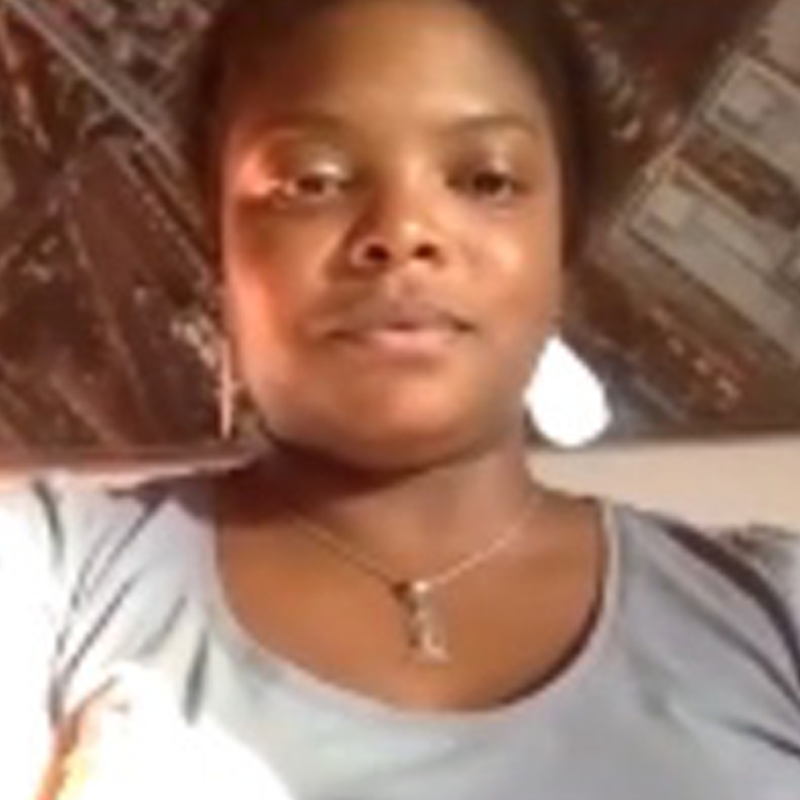
Interviewer Name: Cherron Murray, New York, NY
Interviewer: Asiato Tambadu, Amherst, MA
Date of Interview: Friday, October 23, 2020, Via Zoom
Topic: Teaching during the COVID19 Pandemic
Asiato Tambadu: This is Asiato Tambadu. Today is Friday, October 23, 2020. I am interviewing Cherron Murray for the Covid19 Oral History Archive. This interview is taking place over Zoom. This interview is sponsored by Hampshire College and is part of the First Year Seminar, Pandemics. Cherron, thank you for being here via Zoom.
Cherron Murray: Thank you! You’re welcome!
Asiato Tambadu: I wanted to ask where you are currently located?
Cherron Murray: I am currently located in New York City.
Asiato Tambadu: I am located in Hampshire College, Amherst, Massachusetts. I would like to ask you for permission to deposit this interview into the Hampshire College COVID-19 Oral History Archive.
Cherron Murray: Okay. Yes, I give you permission.
Asiato Tambadu: First, I wanted to ask, what is your full name and year of birth?
Cherron Murray: My full name is Cherron Murray. My birthday is January 11, 1978.
Asiato Tambadu: Where are you originally from?
Cherron Murray: I’m originally from Philadelphia, Pennsylvania.
Asiato Tambadu: May I ask, what is your occupation?
Cherron Murray: My occupation is College and Career Access Coordinator for Children’s Aid Society in New York City.
Asiato Tambadu: Which grade/subject do you teach?
Cherron Murray: I teach 11th grade Advisory, but I also do deal with the 12th graders, regarding post-secondary education.
Asiato Tambadu: How long would you say you have been a teacher ?
Cherron Murray: I’ve been a teacher since 2006.
Asiato Tambadu: How did your school administration respond to the pandemic ? And what did that mean for you as a teacher?
Cherron Murray: I think my administration did the best they could with what they had, basically. It was kind of out of the blue, like the school pretty much closed and we only had a week to plan. So I think they responded the best they could. For being thrown into a situation like that, I think they did a really good job.
Asiato Tambadu: What kind of changes did you have to make to continue to teach during the pandemic?
Cherron Murray: So, actually, New York is like my second home. I actually moved here from Maryland, so I still have a house in Maryland. Because my apartment is so small and both me and my husband are educators and we’re constantly in calls and dealing with students. And we have such a small apartment, so we had to pack up and go back to Maryland. So we would have enough room and have separate places to, you know, basically do our jobs.
Asiato Tambadu: Do you think online school works for most students? Why or why not ? And what are the challenges you are facing when it comes to teaching remotely?
Cherron Murray: Presently, I do not think on-line school works for most students. And not in a high school…anything high school and under. Because I feel like these are the formative years. This is where they [students] are creating relationships, starting to learn about themselves. So, I think it’s important to have social contact on a regular basis. If we could have, for instance, had school three times a week, where a large group of students would come, … students would do better. Just being fully remote, right now in this very hybrid situation, students don’t have a lot of interactions or one on one contact with peers or teachers. I think it does not work for most students, especially students who come from families who don’t really inquire or “support” them while they work in physical school. So, they have a parent who might not have been hands-on with school, but in school, they had teachers who are hands on with them, so it supplemented some of that.
And even students who have support right now, parents are under a lot of pressure. The support might not be exactly the same, because it’s different when you’re supporting your kid, kind of as a second hand teacher, as far as academics. But, when a parent is fully in, and they’re not educators and they don’t know the pedagogy, it’s a lot of stress for both the kid and the parent. Because the parent doesn’t know how to support the student and the student may be upset that the parent can’t support them. Or, they knew that the teacher was their support.
Some challenges I am having: engagement. Students are disconnected, physically. And they’re not engaged. You have students who you know, they cannot go outside and they have nowhere to go. They’re stuck in the house all the time, so they’re not maintaining routines that they had when they were in school. So, they’re not getting up out of the bed, they’re not getting dressed. That then creates this behavior of, in my opinion, lethargic kind of behavior. They’re in class, online, and they’re lying down, instead of in a chair. And in New York, the students aren’t mandated to turn their screens on. You ask them, you promote it, but they don’t have to. But, I understand, you don’t know what the conditions are, the kid might not want you to know where they live or what’s going on in their home. So, I respect that. But because there’s not a mandatory cameras-on situation, kids are laying down. They are not in a routine. They don’t get up. They don’t feel like they have motivation to go anywhere and it just creates this behavior of, kind of lethargic, and just lazy, for lack of a better word, behavior.
Asiato Tambadu: Definitely. Please describe the adjustment you had to make as a teacher.
Cherron Murray: Just working from home. I also have to make sure I am fully keeping up with my routines, because when the pandemic first started, I was kind of, I’ve never worked from home. I had to really, really schedule my time. I have to have some kind of time management because if you’re at home, you could work all day, all night. Kind of wear yourself out. So I had to really manage my time. When you’re in school, your time is managed by the bell and your time is pretty much managed for you. But now I’m working from home, I never worked at home before, so I had to get used to doing that.
Asiato Tambadu: What steps do you feel like the school administration could have taken to prepare both teachers and students for a remote learning setting?
Cherron Murray: One of the big issues I found with New York in particular … it’s very hard .. the student body here is so huge. New York City has so many kids, so many students. They are not dealing with a small group of students, so they’re trying to figure out what is going to work for everyone, so with that, they kept going back and forth, and that was very confusing. Some of the things they could have done was clearly make — and I know it’s hard — but because you’re uncertain, they could just make a decision and say: everybody stay home. I think that would’ve made things clear. People would have been prepared. The administration and schools would have been able to properly prepare. It would’ve been easier to prepare because the schedules wouldn’t be all over the place, especially when you’re dealing with a high school and a middle school model. Everybody has a different schedule, so now you have a situation where kids have different schedules, some students are coming in the building, some teachers are coming in the building, so teachers are not, so you need people to support the kids who are in the buildings. Teachers who are in the building might not really be able to support the student, but they are just there, and the kid is on the computer anyway. So, you have a student that, in the schools, learning on the computers anyway [despite being in a physical classroom]. I get the option, because some kids are like, “I just need to get out the house,” but a lot of kids said they need to get out the house, but now they’re like “No.” Because they were thinking school was going to be normal: I’m going to be at school, I’m going to wear my mask, and be able to go to my classes. That’s not what it is.
A lot of the kids who opted in to coming to school, have now opted out of coming to school because it’s like they’re home anyway. You know, it’s not school. It’s one room, just like home. I think New York City could have decided to go on-line. It could have prevented a lot of confusion. We are still in a process of making sure kids still have devices, and their schedules aren’t all over the place. We have a very crazy schedule now because there are kids here and kids there, and kids that aren’t here at all. It’s just a lot going on, and you can only have a certain amount of kids inside of the school, so that also creates another layer of scheduling.
Asiato Tambadu: What practice do you feel everyone should continue after Covid-19 dies down?
Cherron Murray: I do like the staggering of the grocery store. I love that it’s staggered. One of my favorite grocery stores, Trader Joe’s, it’s usually so crowded that you’re in a line to get your groceries. But now, because of Covid-19, you can only have a certain amount of people in the store at a time, it’s easier. Now, when it starts getting colder outside, that might be a different kind of issue, but I can do the practice. I love it. I think it’s great. Wearing a mask, especially people who are exhibiting colds, or anything like that, even if there might be a vaccine, but wearing it, is essential for just the transmission of germs. I’m not a germaphobe at all, but I do think because I was wearing a mask most of the year, I think I only had a cold one time. During the year, you usually get a couple of colds, but I only had one cold one time, and I think wearing a mask all the time prevented me from getting the seasonal cold. So, yeah, I think wearing a mask, semi-empty grocery stores — I think that is a beautiful thing! I think we can keep those things.
Asiato Tambadu: I understand that you moved from New York City to Maryland at the beginning of Covid-19? Why?
Cherron Murray: There’s much more room. I had to have more space. I was sad to leave because I love New York, but my husband and I wouldn’t be able to do our jobs effectively in our apartment because it’s so small. It’s New York, so you know. We had to go back to Maryland to stay in our other home. That was really the main reason: work.
Asiato Tambadu: Again, thank you, Cherron Murray, for joining me on this call. We’ve talked a lot of things. I’m wondering if there’s anything you’d like to add, or maybe something we’ve skimmed over?
Cherron Murray: I mean, just what I’ve been talking about with other educators and parents and just, feeling very, very sad for students. Kids that are trying to experience life like yourself at school, at school trying to have a “normal” school year, and just that, it’s not the kid’s fault. It’s the adults in the world. They’re making choices that aren’t in the best interest of just our children. I don’t think people are thinking about the kids primarily. I mean, they’re going to persevere, but there’s going to be a lot of remnants of not so good things with kids and education. Hopefully, this can change the scope of education, but I’m not really sure about that. So we’ll see.