
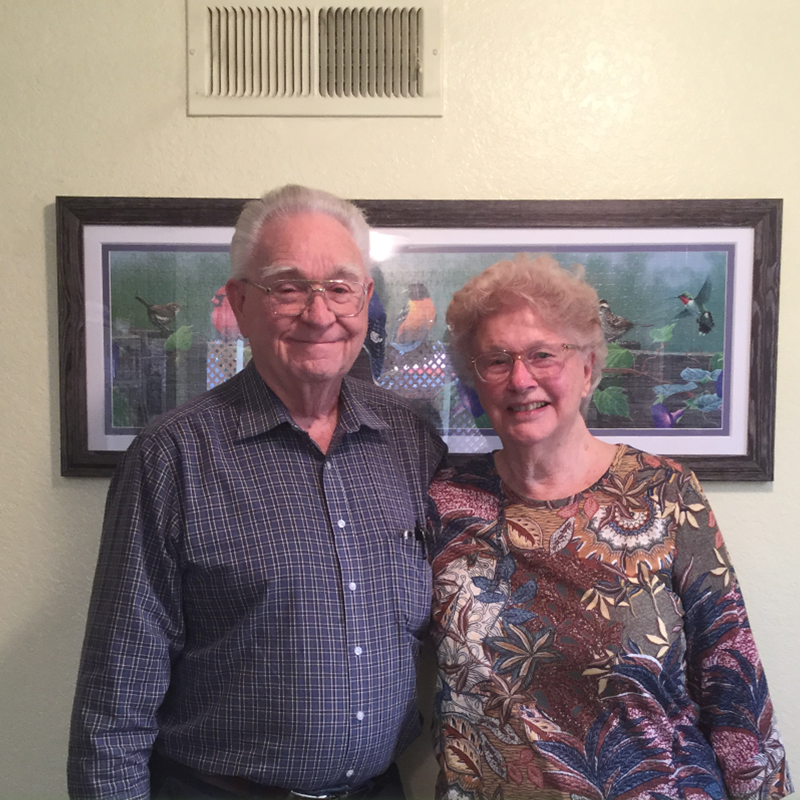
Jim Clark with his wife, Sanna Clark
Interviewee: Jim Clark, Rancho Cucamonga, CA
Interviewer: Robert Wasik, Amherst, MA
Date of Interview: November 13, 2020, Via Zoom
Subject: Senior’s perspective during Covid-19 Pandemic
Robert: Okay, it’s recording. This is Robert Wasik. Today is November 13th, 2020. I’m interviewing Jim Clark [spells name] for the Hampshire College COVID 19 Oral History Archive. This interview is taking place over Zoom and this interview is sponsored by Hampshire College. And is part of the First Year Seminar, Pandemics course. So what is your name and can you spell it out?
Jim: My name if Jim Clark [spells it].
R: And what year were you born?
J: Well, May 24, 1932.
R: Thank you. And where do you live?
J: Rancho Cucamonga, California.
R: And where did you grow up?
J: I was born and raised in California. Mostly my folks moved around a lot, but from my teen years until today, we were right here in the Rancho Cucamonga area.
R: And what is or what was your occupation?
J: I started out as an electrician for Southern California Edison Company and worked for them for 35 years and retired.
R: Do you have any family, children?
J: We have one son that passed away last year and I have two children that live in Washington State.
R: Do you mind giving their ages?
J: Well brother, let’s see. I think my daughter is 60… she might be 68, I think. And my son would be 66. It was two years between him and the one that passed away. It was six, would have been 65, had he lived.
R: Okay, so how has the pandemic affected your life right now and in what ways?
J: What was it, what did it?
R: Sorry, how has the pandemic affected your life right now?
J: Oh boy, well, we don’t get to church. Which I don’t like. We’ve always been active in a church, but we can’t get there. And we don’t, not have, not being able to have friends over to visit or we don’t go visit friends. So it’s been kind of isolated for us. We have your mom and dad come over and share, but they’re the only ones that come to our home ever since this Covid-19 came to effect.
R: Can you describe your average day since the beginning of the pandemic?
J: Describe what?
R: Your average day?
J: Oh, let’s see. Well, we get up early. We’re usually up around 6:30 and we have breakfast. And if we have any shopping to do, we do that before, trying to get all that done, 10 or 11 o’clock. And then, well in my old age, I take a nap every afternoon at 2:00. Then, like later today, we’re going to go pick up our great-grandson, who’s 14, and he’s going to come and have dinner with us, and he usually does that about twice a week.
R: How do you go grocery shopping?
J: We go to a Stater Brothers Market. It’s about a mile and a half, two miles, away. We drive our car down there.
R: Okay and has your physical health been affected?
J: I mean by the …?
R: By just being indoors, have you been?
J: Well yeah, I think. Well, because we don’t, we don’t, exercise. I used to be with … my wife and I used to go for walks in the park. And go to the Senior Center, and walk, or do the exercise machines. But since this all started, we just don’t walk much. Other than what we do when shopping.
R: What other adjustments did you have to make?
J: Oh, gee let’s see. I don’t know, I can’t think of any … Otherwise, our life is pretty much the same as always. It’s just getting out meeting people and going to church or things we miss. That we miss that a lot.
R: So, how have you been coping with those adjustments?
J: Oh we what?
R: Been coping with those adjustments?
J: Well, some days it’s sometimes, it’s kind of disgusting. We’ve always liked to be around people, but we have. So I try to read a little bit. My wife’s eyesight is going away. She’s losing her eyesight, so she can’t read. So I try to read and communicate with our children on the Internet. On the iPad. I talked to them about once, well maybe two times a week, on there. And so, I guess basically just, it’s, I don’t know. Just kind of, I don’t like it. I don’t like the idleness. I’d like to be busy, but with … we just haven’t been able to make it, with it. You can’t go out to eat lunch anywhere. There are restaurants, are closed as you probably all know that. And so maybe about, probably once a week, we go to In-n-Out Hamburger Place. I know you like those probably, but we do that. And about once a week other than that, but you know. My wife’s a good cook and so I get good food at home.
R: So how has COVID19 affected your mental health?
J: My mental health, have been on that. Well actually I think … because I do more reading and I do a little more studying. I’m trying to learn a little bit more about the connection between our English Bible, and the Jewish Bible. So on my iPad, I communicate with some people in Israel, and I try to read that, I talk. I don’t talk to them, not literally, but I read their material and I study that a little bit. And I guess the other thing, in the evenings, I probably, we watch TV for a couple hours and we’re usually in bed by 8:30. So we get up about 6:30 and go to bed at 8:30.
R: I’m interested in you talking to those people from Israel. Would you have done that without COVID?
J: Oh, I started it before COVID came into reality, But since that time, I spend more time communicating with them. They send a lot of literature over the iPad. And what they’re doing is they’re showing the difference of what the Hebrew Bible says about, talking about the New Testament, you know. Which was written in Greek and Arabic. And so in their thoughts, could we, with the Hebrew or the Jewish lifestyle. And they still hold to some of the old ways of life. Which are chained [??] differently than ours. And then it affects the way the Bible was written. At least that’s what they’re trying to explain, so it’s a very interesting study.
R: Yeah, so has that been, like helping you cope, as well?
J: Say again?
R: Would you say that that also helped you cope? Or is it just for fun?
J: Well, it’s not just for fun. I would like to know all I can ever possibly know about the word of God. And that’s why I got started with talking, not talking to, communicating, with the people in Israel. There’s actually these people in Israel, are Born-Again Jews. They’re Christian Jews and so I try to, with their literature, that they talk to with, or I say talk, but I mean read. They explain a lot of the different books of the Bible. And how Jewish people look at it and how they would interpret it. And of course that means a lot to why they’re having trouble with sacrifices [???] and Jesus and Son of God.
R: What I was trying to say was, like does that help you keep your mind off of COVID?
J: Well, I’d like to keep my mind off of it, (laughs), but you know, it’s so prevalent in everyday life that you know. I mean, you can’t even go out of your house without hardly putting your mask on and the stores and stuff. And of course, like right now in California, we’re having another burst of more people. …I think I heard on the news this morning, over a thousand people. Who came down with it yesterday and the day before. So it’s bouncing back up and becoming worse. And so that makes us, as older people, stay home because older people are … when older people get it, it’s harder on their physical being. So, they warn us not to get out amongst the people. So that, again, just kind of keeps us from shopping for things other than what we have to have. But I don’t know (short pause). It’s kind of (pause). It’s kind of, it’s making life difficult. But the ones I think about more often are the people that have children, young children you know. They’re not in school and they have to do things. So anyway, I don’t know if that answers your question, Robert? I’m sorry.
(phone ringing)
R: It’s fine, yeah that helps our answers. So, do you feel anxious or concerned, a lot, much? Sorry I had a phone call, it’s not the right one though, that’s why I was kind of distracted.
J: Oh, and your question was?
R: Oh, so do you … Back on topic, do you feel anxious, since?
J: Anxious? Let’s see. No, I don’t think so. We do our best to not to get involved. You know, be out amongst the people, so I’m not. And I know that God is taking care of us and watching over us. We trust him quite heavily and we’re very careful about what we do. So well I believe that we’re going to be okay. And I worry about my, my family, my kids, and my grandchildren and stuff like that because some of them are not well. When I say not behaving well, you know they don’t wear the mask and they congregate with larger groups. And so, I worry about them. But for as far as for my wife and myself, I’m not anxious about life as far as COVID19 is concerned.
R: So are you picking up any new or old hobbies?
J: Hobbies? No nothing new. I like to … I’m an amateur radio operator and I get on that probably once a week and try to talk to people around … southern California. I have a little hand-held amateur radio and I could talk to mostly any city in southern California. So that’s about the only thing, only hobby, I have other than reading or listening. Well my other hobby probably was listening to music. I like music, mostly [big] band music of the ‘40s and ‘50s and the ‘60s. And of course, gospel music, old-fashioned gospel church music, I like that too.
R: So how has the pandemic affected your relationships with your family and friends?
J: Well, like actually it’s been kind of bad, in a way, because we don’t communicate with them as much. You know we don’t get a chance to sit over a cup of coffee and visit and, of course, my children live out of state. Our daughter was down here about four weeks ago for four days. My son was here last year. And they come down from Washington about once a year, and stay a couple of days. But there are our local friends and stuff, that you know … we don’t [have] coffee anymore or tea because you’re not supposed to get together.
R: Are you optimistic for the future given the pandemic we are in?
J: Say that again, Robert?
R: Are you optimistic for the future given the pandemic we are in?
J: I am for myself and my wife. But … I’m concerned about the populace around us. It’s in every state, but I’ll talk about California. You know a lot of people are upset and irritated because they have to wear masks, but they don’t realize that that’s one of the … wearing their masks, and washing their hands, and not congregating in big groups where people don’t wear masks. If they don’t …learn to do that, they’re not going to get rid of it. It just keeps cycling over and over again just like over the last holidays.
We had people gather together in large groups with no masks, now we’re starting again. You know, 14 or 15 days afterwards, there’s more people coming down with it. Well if everybody had worn a mask, there probably would have been less people getting sick. But it seemed like … just like the other day, I go to the market and …(zoom froze)… and darn mask, they get so sick and tired of wearing them. But she doesn’t realize if she didn’t wear them, you know.. She could either come down with it, or she could give it to somebody else if she had it because that’s our only protection. That we have available to us. It is you stay home, or you wear the mask if you’re out. So people need to be aware of that. And that kind of concerns me about our populace, yeah.
R: Okay so we’re starting to end now and we talked a lot about a lot of things. Is there anything else you would like to add?
J: No, I don’t, I think we’ve covered everything. I just, as far as the Covid-19, I think people should think about it as more seriously than they do. I don’t think the… you’ll have to excuse me for this, but I think the younger generation thinks it’s kind of foolish that we go through this. And they don’t realize that they’re congregating in groups without the masks. That they’re either, they could get it, or if they had it, they could spread it so easily. And I go back to the days of polio and and flu way back and, you know, well like, 1918, I think it was. They had the big flu, Influenza, come over from Europe over here. And they had people lined up. Laying in hospitals all over the place. And the only way they got rid of it was to isolate people, and pull them out.
Same kind of the same process, but the people had to learn the same thing. But now, you see the younger generation doesn’t know. That they didn’t go through that and of course neither did I but I was shortly after those years. I was born and raised to see. Now every year, we get a shot for (chuckles) for the flu. And one of these days, that’s what they’ll have here. Fact of matter, you know, they’re working on it now. Getting a shot for this Covid-19 and I hope that they can come up with it soon. But in the meantime … (Freeze) so it’s become … (freezes) it gets back up because people are not taking (Zoom Freezes).
R: I’m sorry. You froze for a long time. Can you repeat?
J: Oh I was just going to say, I wish people were [to my time??]. All I knew quite, last your question, other people would pay more attention to … staying aware of the Covid-19. And covering themselves with their masks and stuff, so we could finally get rid of it. And the other, I guess the other aches of politics nowadays are kind of a shame. But that’s another subject we don’t want to get on. (chuckles)
R: Okay, thank you for this interview. I’m going to stop recording but you should wait in the call and I’ll be right with you …