
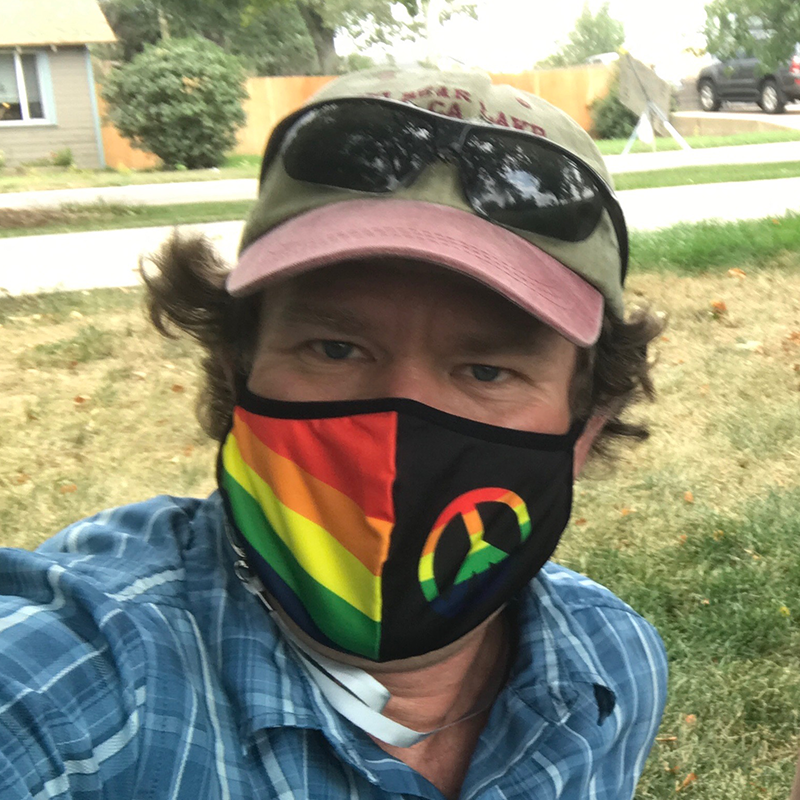
Interviewee: Max Maclay, Aurora, Colorado
Interviewer: Maisie Maclay, Amherst, MA
Date: October 14, 2020 Via Zoom
Topic: Teaching During the Pandemic
Maisie Maclay: This is Maisie Maclay. Today is October 14th, 2020, and I am interviewing Max Maclay for the Hampshire College COVID-19 Oral History Archive. This interview is taking place over Zoom. This interview is sponsored by Hampshire College and is part of the First Year Seminar, Pandemics. Can you please spell your name for me?
Max Maclay: M-A-X M-A-C-L-A-Y
Maisie: Where are you located right now?
Max: I am in Aurora, CO. Just east of Denver
Maisie: Alright, and I am at Hampshire College in Amherst, MA. Do you give me permission to record your words and deposit this interview in the Hampshire College COVID-19 Oral History Archive?
Max: Yes.
Maisie: Thank you. Can you tell me some basic biographical information: where you’re from, what your occupation is, and how many years you’ve been working in it?
Max: Well I am from the Colorado area – Evergreen, CO, just up in the mountains – and I am in Aurora, CO, where I’ve lived the last… since 2007, so the last 13 years. I am in my 23rd year as a secondary school teacher, and my 14th year as a middle school teacher at a small independent school.
Maisie: Awesome, thank you. Can you tell me where you teach now: the name of the school and the location?
Max: Yeah, it’s called the Logan School for Creative Learning. It’s in Denver, CO, and it’s a funky little school where basically kids say “Max, this is what I want to learn” and I help them do it.
Maisie: What grades or ages do you teach?
Max: In my class I have 6th, 7th, and 8th graders.
Maisie: How many years do kids generally spend in your classroom?
Max: I would say the average is two. If I get someone who’s a sixth grader, it’s pretty common that they would stay with me for all three middle school years. But yeah, generally two years.
Maisie: Can you tell me about how your school responded to COVID-19 back in March of 2020?
Max: Yeah, so in March we had actually two days to plan their unit, and we were having all these staff meetings instead, and going “Alright, everybody’s got to get ready, I think we’re gonna be going virtual,” and we had no idea what that really meant because we’d never done it before. And so we had all these meetings on Thursday, and we tried to get stuff kind of ready to go, and then we walked out of the meeting and what we’d planned had already changed – or what we’d planned for had already changed – and so they said “Oh, uh figure out what you can for being ready to be gone for a week, starting in a week, and we’ll have an extended spring break”.
And then we got home, and I got a text that said, “The governor has closed down all schools in Colorado. You can come in tomorrow to get ready for next week, but we are virtual for now.” So, that was us kind of going “Oh gosh, what are we gonna do?” So we — me and my teaching associate — got a couple of books for each kid that we could do book groups with, and we got a couple of projects together that we thought we could do. And we were thinking, “Alright, this will be like two weeks or a week, and then we’ll probably be back.” And then we just kept adding on virtual learning until next thing you know, we’re doing 8th grade continuation [commencement] with a video and a parking lot parade of all the kids in the cars through like fifty teachers waving, and that was it.
Maisie: Wow, that’s rapid adjustment. And so you already kind of answered my next question, which is how you adapted to the Pandemic back then. So it sounds like you kind of gradually added more and more weeks to your virtual learning plan, right?
Max: Yeah, so I don’t think I’d ever used Zoom before, I don’t think I’d ever used Google… whatever their Zoom function is. But we started trying that one and then we experimented on Zoom the next day and I went “Oh, I can mute everybody on Zoom. That will be more helpful.” Actually I’ve noticed a difference of not being able to do that in the classroom this year (laughs). We just kind of kept going, “Alright, we can still do a lot of work through Google Classroom.” I am not a teacher that lectures to teach, I am a teacher that helps students figure out what their questions are and then gives them the opportunity to figure it out. And so, then, we had a lot of one-on-one meetings. And so we were able to just do that throughout the year, and it wasn’t perfect but it… It went well enough.
Maisie: Yeah, that’s all we can hope for sometimes. So this fall, this year, what are your classes like? Are you guys completely online, or hybrid learning, or in person?
Max: We are 100% at school, I have a full class of 23 kids, and we see each other every day. And out of our Kindergarten to 8th grade school, I think there are 11 – 14 kids that are online all the time. So we have what’s called an online one-room schoolhouse, so there’s 5-year-olds to 13-year-olds basically in an online class with a teacher dedicated to them. And then everyone else is at school.
Maisie: That really interesting. What does being in person look like? How are you maintaining social distancing, and what do that look like in practice?
Max: Well there’s a lot of… It’s really different, and it’s hard. Everybody wears a mask. You try to be at least three feet away from everybody and hopefully six. There’s obviously not enough room in the school building to do that. We have a pretty good-sized campus, so each classroom has basically a big wedding tent without walls – so it’s got a roof, but no walls. So I have an outdoor space that’s 20×30. I took a big area rug and laid it down in the middle. We have a bunch of camp chairs out there; we got a bunch of folding tables. And I let the kids spread the tables out around our tent. There’s a tent with 7 and 8-year-olds about 50 feet away, and so, you know with middle schoolers, you have to talk about leadership and language and screaming because middle schoolers are loud. And then, you know our classroom has most of the supplies so luckily there’s two teachers for each classroom, so we’ll kind of get the kids going outside and then say “Who needs to go inside to do work?” or “Who needs supplies from inside?” And so one of us will go up, and we might have as many as 10 kids inside and 13 outside, but usually it’s just a few inside. We do the best that we can to do the work we can. It’s been hard.
Maisie: That’s really different. Now that you are shifted from a normal classroom environment, how have your goals changed? What are your goals for yourself as a teacher or your students as learners?
Max: Well, honestly, it took me a while to figure out what was going on this fall, because everything was just three steps harder. Everything I’d ever done in 23 years of teaching basically was for a different situation than I was teaching in now. My wonderful brilliant tricks or ways that I’ve don’t — time-management or classroom-management was harder and you know I’m someone who makes a lot of jokes and is sarcastic and fun, and that doesn’t translate as well through a mask. Or even just the fact that when you’re outside the kids are spread apart farther, there’s dogs walking by on a walkway nearby with people, there’s squirrels, literally running out of the tree up above us, and so it’s just harder. And it takes longer to figure things out. So, I would say, you know we’re in our 9th week now, and I’d say it’s been the last three that I finally know the expectations I have, and an understanding of what I need to do to get there. And now it’s sort of like training the kids on like “Hey, this actually how we need to act now”. So I feel like we’re seven weeks behind in that.
I would say my goals are that we’re safe. We’re actually decently happy most of the time. And then each kid can find some ways to show the growth that they’re having. But I also know that it’s not going to necessarily be as fast or look as good as usual.
Maisie: Those are great answers. So, you’ve definitely touched on some of the challenges of teaching in this new way. Are there things that you’ve learned from teaching in this setting that you feel like have maybe bettered yourself as a teacher or that you might bring into future years where hopefully we are in a more normal environment?
Max: Well, I think from last spring, learning how to do Zoom, and how to teach on Zoom opens up options for being able to like, if I have a kid who’s out for some reason but they’re healthy enough to participate online, I can Zoom them into class. I haven’t actually done that this year, but I will be doing that tomorrow because I have a student that is going to be gone and I want her to be part of the writing lesson that we’re doing. So I have to remember to send her a Zoom link tonight (laughs) and I have an alarm set on my phone to make sure I remember to try to Zoom her in, but I think that’s something that’s going to be useful. And I guess the other part is even though it’s been really hard this year, and we’ve outside and inside and stuff is just weird, in the end, the relationships matter, and the kids are doing some pretty cool work that I think is showing their learning. So I’m excited to be able to reflect on it more as the year goes on and kinda see okay where did we really get this year and where did growth happen? And I think we’re still trying to see the kind of growth the kids are going to have personally, rather than just academically.
Maisie: That’s really powerful. AS you said, kids generally spend more than one year in your class, either one two or three, and so you already know some of the students in your class this year, I gather. For new students entering your class this year, how are building connections and relationships with them, without your usual your usual methods?
Max: Well I mean, I’m still Max, and so most of them know me from around the school, from lunch duty and I’m relatively obnoxious to most people in a friendly way, and so they know me. But yeah, I think I have fourteen new kids this year, and so that’s a bigger number. I’m working really hard to make sure I get a lot of one-on-one time with each kid, because I think the way that works best for the teaching I do and the teaching we do at our school is making a real connection. They have to know that I see them. Honestly it’s kind of hard to let them know I see them when everything just takes longer. So some of the learning about who they are and what they do has taken longer, but I still just need to focus on that, whether it’s their mask choice that they’re doing or the different skills – one kid pulls out a harmonica all the sudden, one kid is doing handstands, or someone else is like “Yeah, I’m coding and I’m going to make this thing that can find your password, let me show you how I can do that,” and so it’s a lot about just making those connections still.
Maisie: That’s really cool. And then how are you building community or facilitating community-building between students, like student-to-student connections?
Max: I mean at least we get to see each other. People are people and they’re gonna gravitate into groups; there’s gonna be little cliques of friends and new friends that happen. I talk a lot about, from the very beginning of the year, “Hey, especially those of you who are veterans in my class, how are you reaching out to the new people, so you’re not just being clique-ish with the people from last year? And so like when we make groups, I know you’re gonna grab your best friend, but grab someone who doesn’t have a group yet too.” And that’s something I actively talk about every year.
I try to give lots of opportunities to share stuff about yourself. We have a soccer ball that has probably sixty different questions on it, and we’ll just toss it around and say like “right pointer finger” and whatever question it lands on, you read the question and then your answer. It might be “ice-cream, what’s your favorite flavor”, or you know, you might say “red pill or blue pill” — which I have to explain what that means to a lot of them –- or you know, “dogs or cats” or “what’s one thing you wish your parents knew about you” or that “teachers knew about students,” and things like that. And so there’s a bunch of different questions, and eventually everybody ends up with a couple of the same questions and so everybody kind of know “Oh that’s a dog person who likes chocolate.”
And so like those are different ways that you get to create community. And then, I don’t know, I think community’s really important in middle school especially because everybody feels more different than at most other times in their life. And so giving people the opportunity to safely share who they are, or who they want to be, without a ton of judgement, and just accepting that “oh yeah, I’m wearing pineapple socks,” or “You’re the tallest kid and that’s good thing not a bad thing” or just things like that. So that’s a lot about creating community, and helping people check themselves when they make inadvertent reactions, or either thoughtless or not very thoughtful reactions, or just occasionally mean because sometimes we’re all mean. I try to call them on those things, and let people know that it’s a safe place to be you.
Maisie: I love that idea of creating a space where people can share both who they are and who they want ot be. I think that’s so important in middle school – as it is in many times throughout our lives, but middle school especially. So, are you engaging at all with the COVID-19 pandemic in your curriculum and in your teaching, and if so, how, and if not, why not?
Max: We definitely talk about it. I mean, politics comes up because of course it’s an election year. I have some really really really passionate kids about the election. And you know, we’re in Denver, it’s a much more liberal area, but I really try to make sure you know, there’s almost 50% of the people are going to vote in a way they don’t agree with, and why would they do that, and that even some of them are really brilliant and smart. And I also try to talk about how there’s actually a whole bunch of other people who are not necessarily Democrats or Republicans who have a lot of other ideas. It’s just not the way the system’s set up, and so I try to open their eyes that way.
And then as far as COVID goes, I mean it’s a lot of education about what we think we know, you know it’s a new enough disease, and the facts have been very… there’s a lot of questions about what the facts are these days, unfortunately, and especially with science. So we’re trying to be thoughtful about “What is the truth as we know it, or what are the facts we think we know? What are other things we’ve heard? How has it changed?” Science does its best job: “Hey here’s what we think” but then facts change, or new information comes to light, and then new conclusions can be drawn. So there’s a lot of that going on. So we try to talk about those things thoughtfully. And I wouldn’t say that we’ve talked about what exactly COVID is, but there’s obviously a lot of conversation about “how far apart we need to be” and “why are washing our hands” and “why are we wearing masks” and when we have lunch, we have to be farther apart, and how it’s different when you’re outside versus when you’re inside because the air is moving around versus staying relatively stagnant.
Maisie: That makes sense, it’s definitely inevitable, but I’m glad that you guys are having really thoughtful conversations, it sounds like. So do you discuss with your students at all other issues that we’re currently facing, most notably the Black Lives Matter Movement and climate change, and if so, can you just briefly tell me about what kinds of discussions that looks like amongst your kids?
Max: So I do, I call it morning meeting, so every day the kids come in, just like in elementary school, and we sit in a circle, roughly, and chat about whatever – we kind of wait for everyone to come in and we talk about the day. And sometimes I’ll bring up stuff or somebody brings up something and we talk about it. We’ve had a lot of discussions about oppression. Actually some of my units this year that some of my kids are studying, one is studying oppression, one is studying racism, one is studying climate change, literally. So those are topics that I’m talking a lot about individually with those kids, but there’s a lot of sharing that goes on. Kids see something that someone’s working on and go “Oh my god, I’m so interested in that too” or “What’s that? That’s cool”, and so all the units get discussed one way or the other. And then like when we go to book groups, which we will one day, some of the books that we have planned are The Hate U Give, which we also did a book group last spring on. But we wanted to do it again just after the spring and summer that we’ve had because it’s a powerful book.
Another book that I have planned is called The Autobiography of Miss Jane Pittman, which is actually a fiction book but it follows a woman who was born a slave and started out as a slave, and it’s told as an interview over the course of a book in her 90-some year old life, as she lived through Reconstruction and Jim Crow laws and into the beginning of the Civil Rights Movement. So that’s another one. There’s one called Ninth Ward which follows — and it’s a little younger reading book (but there are a lot of reading levels in my class) — but it follows a girl who’s in the Ninth Ward during Katrina in New Orleans. It looks at poverty and it looks at a little bit of magic, as is kind of common down in New Orleans as well, and being a seer, but she’s African American and lives with her grandma. And they’re in the Ninth Ward, so everything floods and they have to cut their way onto the roof with hatchet type of thing. So some of the book choices that we’ve chosen, that we’re going to talk about in depth in our book groups, are kind of on that Black Lives Matter thing.
Maisie: That’s really cool. You mentioned a little bit about how some of your students have chosen relevant topics as their individual projects, so can you just explain a little bit about how Logan is structured and how your classroom is structured, and then also just if you’ve noticed any changes in the type of things that your students are studying in this weird time – like you said, some of them are studying big topics right now, so I’d love to hear more about that.
Max: I would say that the topics they’ve chosen every year are usually relevant to the time. You know, it’s 2020 and there should have been the Summer Olympics. I’ll usually get at least one Summer Olympics unit when there’s an Olympics and the kids just spent August watching the Olympics, but not this year. I’ve had a lot of kids study relevant things; I’ve had a lot of political units come up on election years. I’ve got one kids studying “Predicting Presidential Races,” another one who studies polling, so it’s always topical. And then what I work to do, and what all the teachers work to do with their students, is to say “Okay, this is hopefully your passion, what you’re excited about. What might you study even if you didn’t have support, and so what are your questions? What do you want to know?” And at different levels, you have to say, if you’re studying Mt. Everest and climbing Mt. Everest, a question could be “How tall is it?” but that’s a quick answer. So instead you might say “How do you climb Mt. Everest? What is the right route to climb?” or “How many people are needed to support one person to get to the top of Mt. Everest?” So that’s a bigger question without necessarily one answer. And then we talk about what kind of projects they want to do: “Do you want to write essays? Do you build things? Do you want to make a movie?” and things like that. So that’s kind of the process a little bit.
Maisie: That’s fantastic. Well we’ve talk about a lot of things. Is there anything that you want to add, or something that we skimmed over?
Max: I don’t know, I mean I would say just in this era in COVID it’s been… It’s been hard. I think that I’ve seen a real erosion of trust in our government and in people, not that it was highly highly trusted in the first place necessarily, but just that I think that there’s so much misinformation that there’s just not a lot of trust even on what should be facts. You know you kind of go “Okay, so what even are the real facts?” And so I think that part has been hard. I think that we’re all really missing people. I had plans to come out to Washington a couple of times and see your whole family, and that didn’t happen. And so, you know Susie and Patti, I take them groceries every week, I haven’t hugged them since March. That’s weird. So it’s been sad. On the other hand, people are kind of learning new things, and they’re coming together in new ways, and it’ll be really curious to see how social media or the change in the economy in terms of a lot more food delivery happening, and a lot more people buying stuff online, I think that that is going to be a significant switch socially, we just don’t really know what that will mean down the road.
Maisie: Yeah, I second all of that. Okay, thank you for this interview! I’m going to stop recording and then we’ll talk a little bit more after. Thank you!