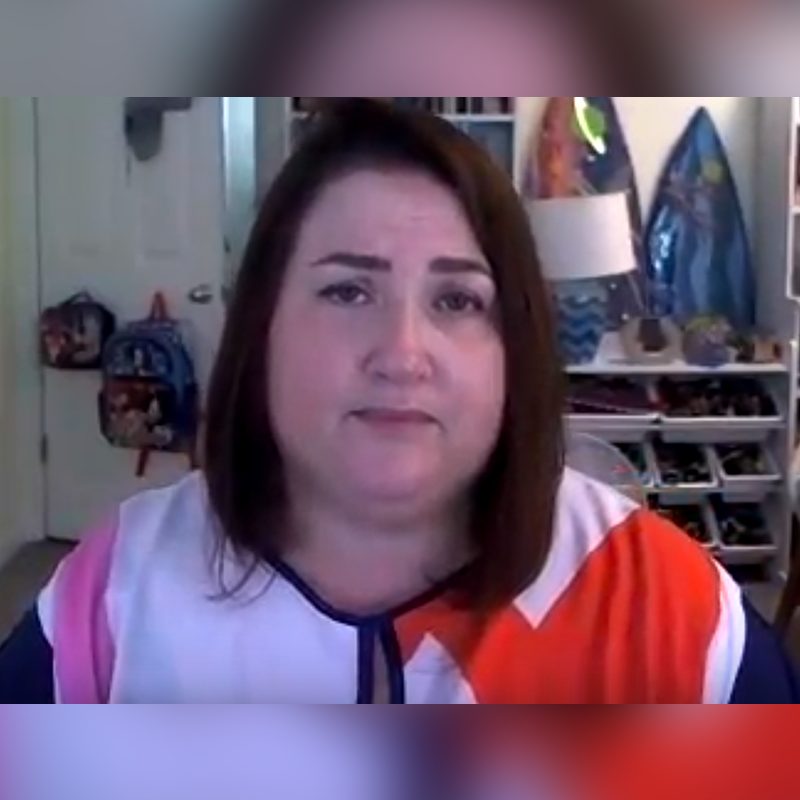
Interviewee: Rebecca Sauer, Coronado, CA
Interviewer: Yarrow Skoblow, Hampshire College, Amherst, MA
Date: October 18, 2020, Via Zoom
Subject: Working as a nurse on the front lines during a surge in COVID-19 in New York City.
Yarrow Skoblow (YS) : This is Yarrow Skoblow. I also go by Aviva. Today is October 18th, 2020, and I am interviewing my Aunt, Rebecca Sauer, for the Hampshire College COVID-19 Oral History Archive. This interview is taking place over Zoom. This interview is sponsored by Hampshire College and is part of the First Year Seminar, Pandemics. Aunt Rebecca, where are you located today?
Rebecca Sauer (RS): I am located in Southern California, more specifically, I’m located in Coronado, California. Right off of San Diego.
YS: I am in Amherst, Massachusetts, on the Hampshire College campus. And I have to ask, do you give me permission to record your words and deposit this interview in the Hampshire College COVID-19 Oral History Archive?
RS: I do.
YS: OK, awesome, thank you. Could you please spell for me your full name?
RS: Rebecca, R E B E C C A Sauer, S A U E R.
YS: Thank you. What year were you born?
RS: 1969.
YS: And where are you from?
RS: Originally, I was born in Binghamton, NY.
YS: What do you do?
RS: I am a critical care nurse.
YS: How long have you been in this line of work?
RS: Well, I got into the medical field in 1994 as an EMT and then became a paramedic. And after being a paramedic for a number of years, I became a nurse in 2006. So it’s been about 15 years.
YS: What is your training?
RS: My training was … I went to an associate’s degree program at community college in Philadelphia. And I worked in Philadelphia in critical care. And I worked in Washington D.C. in critical care, and I’ve been in San Diego for 11 years doing critical care.
YS: So, where do you work, in your regular job?
RS: So I work in UCSD, at University of California Medical Center. Big big teaching hospital here in San Diego. I left the ICU for what’s called the PAC-U. I left for the PAC-U about four and a half years ago. It’s also critical care; it’s surgical recovery. So, I recover people from anesthesia, they come out from the OR straight to me.
YS: When the Pandemic started, what did you decide to do?
RS: Well, it was a very confusing time for everybody. Things were surging in different parts of the world. It was surging in Italy, obviously in China, and it was starting to surge in New York City. We were very concerned that we were going to get a surge here in California, and so we stopped doing elective surgeries because we wanted to preserve hospital beds for people who were critically ill with COVID. So we stopped doing most elective surgeries and because we stopped doing the elective surgeries, things got very very slow. And they were flexing nurses home very regularly, so there just wasn’t enough work to do as a surgical recovery nurse when they were cancelling all these surgeries. So, I was on Facebook a lot, and I was on a group for COVID-19 health care professionals. And I was riveted to it, and really watching closely what was going on in New York City. And very very concerned about my colleagues who were really really struggling in NYC. Very understaffed, very overworked. And I figured that since they didn’t need me here in San Diego, I should consider a travel assignment in New York City.
YS: So, you went to NY. When did you go to New York?
RS: I went on, I think it was April 17th. I think it was April 17th. I came back May … I think I, no.. I think it was April 18th to May 17th or something like that. Just under a month, like 30 days.
YS: And in New York, where did you work, a hospital?
RS: I did. I worked at a small hospital called New York-Presbyterian in Lower Manhattan. It’s a small, it’s a private hospital. It’s a… a very different model from University of California, San Diego. It’s in Lower Manhattan, right at the very foot of the Brooklyn Bridge, right on the outskirts of Chinatown. And it’s what’s called a PA driven model, meaning that instead of having attending physicians and lots and lots of residents, it’s run by physician assistants, or PAs. There was one, it was a very small, little outpost, there was only one ICU. I was technically in the ICU float bowl, but there was only one ICU. So the ICU where there was constantly at least one attending there and a couple of physician assistants there, so it was an interesting model.
YS: How were you greeted by the people who already worked there when you arrived?
RS: They were so welcoming. I’ll tell you, you know. This unit had 20 rooms. Each one was a private room. And right before I had gotten there, every single room, which was meant to be a single room, each room had two patients in it. So this 20 bed unit had 40 patients. These nurses were overworked, overwhelmed. And I came in with sort of the … the cavalry. It was me and it was several other critical care nurses who came. And some med-surg nurses came. And they came to the ICU to be adjunct staff. They couldn’t run the ventilators, they couldn’t titrate vasoactive drips, you know, for people’s blood pressure and things like that. There were certain critical care things they couldn’t do, but there was a lot of stuff they could do. And they were incredibly helpful and those staff… The travelers outnumbered the staff, probably, I would say, almost 2 to 1. And that’s pretty hard to have a bunch of strangers sort of taking over your home turf. They could not have been more welcoming. It was one of the most glorious surprises of going there; how absolutely welcoming they were and how relieved they were to get relief…. [pause]. They were… they were severely traumatized.
YS: Wow. Aside from that, what else were you faced with when you arrived in New York?
RS: Well…. You know a lot of it was the unknown. I didn’t know if they would have appropriate PPE. I didn’t know if that PPE would fit me properly. I didn’t know how intense the assignments would be. I didn’t know if I would be overworked or overwhelmed or overheated. It was more than any … I had to learn a new computer system very very quickly, I had to learn the lay of the land very very quickly and a lot of it was just the unknown. Also, I hadn’t done ICU, per se, in about four years. So there were certain things that… I had to brush up on. And so I think that the hardest thi …the biggest challenge for me was the unknown, not knowing what I was in for. And then the other challenge, the biggest challenge, was leaving my husband and my, my eight year old son. That was…one of the biggest challenges.
YS: So… I was planning on talking about sacrifice and leaving your husband and your child later on but we can totally talk about that now. How did you feel leaving them for this time?
RS: Uh… [sighs] it was devastating in some ways. Andre was seven at the time, hadn’t quite had his eighth birthday. He is on the spectrum. Very high functioning — on the spectrum, but he and I are extremely close; he’s a cuddle bug and very very attached to his mommy, and [long pause]… he-it was.. He fared really well. We talked, we talked, we did Facetime several times a day. We talked on the phone. I mean, we were in constant communication, but when night would fall and it was time for him to, I mean, I was so exhausted, I would go to bed at practically like 9:00 pm Eastern Standard Time, and then when it was time for him to go to bed, which was 11:00 PM Eastern Standard Time, I would, you know, have to wake myself up out of REM sleep to say goodnight to him. And very often, he was crying. He was very very sad and despondent as the time went on, and just saying things like, you know, “Mommy, I want you to come home now.” And… um… it… it was a real… schism, it was a real conundrum for me, because I was helping people who desperately needed me. And at the same time, I was… you know, I felt like I was this ghoul who was letting down the person who needed me most. It… it was a terrible… it was a terrible choice and … and I had to promise him I would never ever do it again.
YS: When you made the decision to go to New York City, where did that urge come from?
RS: You know, I just knew that they were struggling and I felt like I wasn’t needed here and I was needed there. And it was kind of like a… if not me, then who? situation. I was really just devastated on their behalves and feeling very very impotent and purposeless here. It just seemed like the moral thing to do.
YS: So, it is said, that “With great challenges come great rewards.” So in your own words, what is the greatest challenge of this experience and what do you think has been the greatest reward?
RS: You know, it was a really transformative experience for me. It was one of the best experiences of my life. For one thing, when you’re [jokingly coughs] fifty years old, and you know, when you’re fifty years old and you have a young kid, and you’re married and you have a job, it’s kinda hard to go on an adventure, much less, a solo adventure. It’s not … not really in the cards, so I felt very privileged to have been able to have this amazing solo adventure, at my particular stage of life. I was incredibly taken aback by the people that I met. Whether it was the… the patients themselves, the nursing staff who were welcoming, the administrative staff. That was a huge shock, to just have hospital administrators be so on the ground and upfront, and personable and, and accessible. That was an amazing thing. The firefighters, who paid us tributes every night; they would come with their — different battalions — would come with their engines and ladder trucks and ambulances, and they would give us these tributes. And sometimes they would play music, and the “Whoop whoop,” the sirens. They would stand there and clap for us for like a solid five minutes at 7:00 PM every night. The city would go crazy at 7:00 pm every night. Everybody would make a ton of noise, just the people. Strangers on the street, when I was walking home in my scrubs, would, you know, yell “Thank you!” to me. … I had a next door neighbor who I …[chuckles], I was so tired one night, I was trying to get into his apartment. He was next door to mine and I was trying my key and it just wouldn’t work, until finally he just banged on the door and was like “Can I help you?” and I was like “Oh my god, I’m so sorry” and I was mortified. But then I wrote him this card, explaining why I was there, and he wrote me this card back… That I’ll… I’ll cherish for the rest of my life. About, just this card of gratitude. There were just — the doormen at my building, they knew my name from the moment I got there and never forgot.
YS: Where did you stay while you were there?
RS: I stayed in Tribeca, which is… on the other side, like the island of Manhattan sort of tapers down at the bottom; at the southernmost tip. And on one side, you have the Brooklyn Bridge coming over from Brooklyn, and that’s where my hospital was, and on the other side … God, I guess it would be on the Hudson, is Tribeca. And it’s on the other side, and if you walk from Tribeca, I was right on the Hudson. If you walk down and you can see the Statue of Liberty, and you can South Street Seaport and you can see New Jersey and all that stuff. [child’s voice in the back] So …. Yeah, I stayed in Tribeca. I rented a condo.
YS: Throughout this entire experience you kept a very detailed journal. Through your exhaustion, how did you manage to journal?
RS: Well, it was something that I had intended to do. I bought a journal actually at the airport. And then I had my tablet with a keyboard. It was cathartic for me. It was something that just, I just knew this was a very unique experience and I wanted to capture it. And there were some days where I was too tired. There were a couple of days where I just like “I can’t do it” and I caught up the next day. I very purposefully told the management there that I did not want to work more than two days in a row. I worked four 12 hour shifts a week, so 48 hours a week. And I specifically said, “I don’t care if I work weekends, give your staff off weekends, that’s fine, but I just don’t want to work more than two days in a row.” So, I would kind of work one day on, one day off, one day on, one day off, more or less. Some days I would work two in a row, but that kept it from being too exhausting. And again, you know I didn’t have any childcare pressures or any housekeeping pressures, or anything like that. After work it could be difficult, but then on my days off I could catch up.
YS: Thank you. Who is this journal for, who is your target audience?
RS: My target audience was really, I was hoping to get it out there one way or another. My target audience was really anyone who thought that it was a hoax, or wasn’t as bad as it was, or it was fake news, or any of the other conspiracy theories out there. For those who ….refuse to wear masks, who have the luxury of not knowing anyone personally who has gone through it, much less, gone through it themselves. It was really to… bear witness to what was going on. And for my family and friends.
YS: So how did working in New York, journaling, and working in this new setting, affect your views on nursing?
RS: I don’t know if it did really affect my views on nursing. I… sometimes it feels like a calling, sometimes it feels like a job. I hold myself to a certain level of integrity that has nothing to do with what somebody else thinks. It has to do with what I think, and what kind of a job I do that allows me to go home and not toss and turn at night. I bring my A game, I just do. I bring my A game to every situation in nursing. If somebody tells me that this person is a VIP, or a major contributor to the hospital or something like that, it doesn’t affect my care at all. If they’re homeless, if they’re a celebrity, which I’ve also treated celebrities, being in California, it doesn’t affect my nursing care. I’m still going to make sure that they are clean, that they are warm, that their medications are accurate, and that they are well assessed, and that they’re as comfortable as I can physically make them, and that their pain is as controlled as I can make it, and that they are as safe as I can make them. I just …. I just… I just sort of have this philosophy of… of we all will find ourselves in this vulnerable position one day, and I hope I can trust the person who’s… who’s standing over my bed. [shrugs] So I try to be that trusted person when I’m standing over someone else’s bed. And I also consider it to be an honor, to do what I do, you know… These patients are at their most vulnerable. I mean some of them are just as vulnerable as a person can be; as vulnerable as a newborn. And it’s a tremendous responsibility and a tremendous honor to… be able to have an effect on someone’s life when they’re at that level of vulnerability. It’s a tremendous sense of intimacy.
YS: Would you say that your views on sickness or death were changed or affected at all?
RS: Not really. You know, death is a part of life, and it’s a process, it’s not an event. Death is a process and I think what bothered me the most about it was just the senselessness of it. It still bothers me today, that, you know, over 215,000 people have died and that’s probably a low number. That’s probably a low number; those are just confirmed cases. And it’s so unnecessary. And the fact that it’s become politicized, and the whole nine yards, is … it just makes me apoplectic. There kind of aren’t words for it, about how horrible it is. I hate senselessness. You know, young people, especially all the healthcare providers who have died from this, who didn’t have to die from this, makes me really really angry. Um… just the senselessness. These are not natural deaths, these are preventable deaths, and so, yeah, that pisses me off.
YS: Wow, thank you so much. We’ve talked about a lot of things, and I’m wondering if there’s anything you want to touch on, that maybe we skimmed over, anything you want to add?
RS: Hmm, I guess it just goes back to one of the reasons I wrote the diary in the first place, which was to encourage people to social distance and to wear a mask. It’s really exhausting that a certain segment of society is bearing the burden for another segment of society. That there are people who are social distancing and isolating and wearing masks, and doing everything they’re supposed to do, and a whole other segment of society that’s flagrantly disregarding all of that. And… it’s perplexing and it’s upsetting and…. I think I said when I first wrote the diaries that if it inspires one person to wear a mask then that’ll be enough of a reason to get it out there.
YS: As a medical professional, do you have any insight as to where this could be going, at least in the medical field? How do you see this playing out, has anything changed at your hospital in San Diego? Have there been any systematic changes that you’ve seen?
RS: I work for a really reactive institution, unfortunately. The culture of UCSD is just very reactive in nature and not very proactive. I did cross-train when I got back to the ICU, still in anticipation of a surge that never quite happened. I think the reason it didn’t happen in the same way in Southern California, the way it happened in the Northeast, is that the weather is sunnier, people are living outside. People aren’t, you know, all compacted together indoors, tight in cities. It’s just a little more spread out here, so I think it’s inherently safer than somewhere like New York. Even our public transportation isn’t underground, and things like that. As far as where this is going, and how things may have changed at my hospital, we see incredibly sick patients at my hospital. I had a lady who had to have an emergency C-section at 35 weeks, in her late 20’s, no other real co-morbidities, and when I met her, she was on ECMO. Which is, well, her lungs were so destroyed, they were basically bypassing her lungs, allowing her lungs to heal.
She did end up doing okay, but you know, the other thing about COVID, is that there’s so much focus on people being sick and people dying, but what you don’t hear about, is the long-term disability. I think that’s going to be the real legacy of this, the long term disability. They are showing that people who were asymptomatic have lung changes and it basically … COVID causes microclots. It causes microscopic clots, and those microscopic clots go everywhere. It goes to the skin, which is why we see certain kinds of bruises and certain kinds of rashes. It goes to the brain which is why you see encephalopathy. It goes to the lungs, which is why you see all these lung abnormalities. To the heart, causing cardiomyopathy. It goes to the kidneys and liver. It goes everywhere. So you’re seeing all sorts of, you know, people with kidney failure and … I know someone who lost a leg. Because of clotting to their extremity. I think what we’re in for is a lot of disability due to COVID. There are now a lot of different strains, and some are more virulent than others, and I don’t know, I don’t know what the future holds. That’s, I think, the most predictable thing about COVID at this point is its unpredictability. [Pause.] Unfortunately, it’s not like Ebola, which has a very quick, fast burn. One of the reasons why Ebola never really became a pandemic is because people get it and it burns very quickly, but COVID marinates for a while, and like HIV/AIDS, it has this long ramp-up, and people have different trajectories with it. It’s these pandemics with slow burns that are… particularly insidious.
YS: Thank you so much for this knowledge, I didn’t know a lot of that. I did not know about the clotting with COVID. Thank you so much for your insight and thank you so much for doing this interview.
RS: It’s a pleasure to do that for you.
YS: And you just have so much insight to offer, and this is just perfect, thank you. I am going to stop recording, but you can stay here and I’ll be right back, thank you.