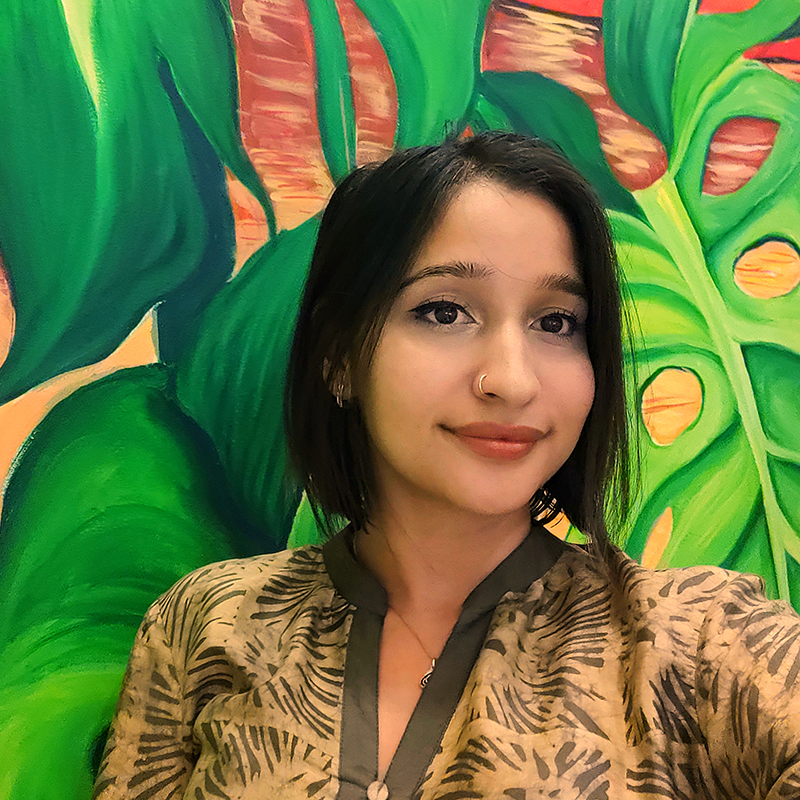
Interviewee: Aliya Adamjee, New York, New York
Interviewer: Aviva Pusey, Hampshire College, Amherst, MA
Date: October 7th, 2020 Via Zoom
Topic: Experiencing Coronavirus/Creativity and Artistic Expression During the Pandemic
AP: Today is October 7th, 2020. My name’s Aviva. I’m here through Zoom at Hampshire College. I want to ask Aliya: Can you please give us permission to do this interview, both audio and visual formats, in the Hampshire College COVID-19 Oral History Archive?
AA: Yes.
AP: Awesome let’s get started. Do you mind introducing yourself? Your name, if you could spell it out as well. And share a few things about yourself. Who you are? Where you come from?
AA: My name’s Aliya Adamjee. A-l-i-y-a A-d-a-m-j-e-e. Right now, I’m in New York. Just working you know, the grind! Originally, I’m from Pakistan. I grew up there. And then moved to Toronto, Canada, and now I’m here. I’ve been making art all my life.
AP: How old are you, so we can include it as well?
AA: I’m 21.
AP: Awesome. Do you consider yourself a painter, a drawer? Do you have a title for you as a visual artist?
AA: Yeah, I think I would say I’m a painter. I’ve been doing more digital stuff as well. Not really graphic design but painting using a tablet, so I’ve been experimenting with that, making prints. I’m trying to connect that with my music because I’m a DJ as well. But right now, I’m a painter.
AP: And let’s just start by asking, where were you pre-COVID? February and early March. Were you in school?
AA: Yeah, I was in NYC, just where I am now. I was going to school, I go to Parsons [School of Design/The New School].
AP: What are you studying at Parsons?
AA: I’m a fine arts major. So yeah, mainly I take classes to do with painting, sculpture work.
AP: And were you working at the time? Any events happening?
AA: Yeah, I had a couple gigs. I had work also at some galleries. I wasn’t officially working pre-COVID.
AP: What was it like at Parsons?
AA: I think it was after spring break, we had online classes. After spring break, I got COVID, and I was pretty much sick for the rest of the semester. I think everyone else was attending classes online, but I was not in the right mindset to do that.
AP: Before we dive too deep, do you know where you were, what was happening when you contracted COVID?
AA: I had some DJ gigs in Puerto Rico. I canceled just before going to the airport because I think that’s when they were saying the City was going to shut down. I also didn’t want to be a threat to Puerto Rico, and wanted to make it back here. I’m from Pakistan right, so I was thinking, because everyone was going home, all of the sudden, but Pakistan’s far. So I was trying to go home. But Pakistan closed their borders that same day. And all my roommates had left, everyone had left, so I was just here. The thing with COVID is like it gives you a little bit of confusion before. You feel like you’re going a little crazy. So I didn’t know I had COVID, my mind wasn’t able to process anything
AP: Do you remember when you got tested and got the results that you were positive for COVID?
AA: Well, no I actually didn’t get a test until May. Because the hospitals were all full. I was calling the ambulance and stuff you know, they wouldn’t let me go in because I was younger. So they just came and treated me at home. I didn’t get a test, but there are like, this is COVID, because I just couldn’t’ breathe. And that’s the only reason why I called them. And I think in May, I got a test and I was still positive. I think I got another test like two weeks later and then I was negative but I still had the antibodies.
AP: Can you talk a little bit more about your symptoms? So you said trouble breathing. Was there a moment when you realized that this wasn’t normal, that it could definitely be COVID?
*** Trigger Warning: Description of COVID symptoms in detail. *** AA: Yeah so I think it was, you know I was going through that confusion. I’ve never had a sore throat like that. It was like there was glass in my throat and my lungs. It hurt so bad, and then my fever went like 104 degrees. It wouldn’t go down, I took an ice bath. It wouldn’t go down. It all happened really quick: I was fine, then I was bad. I was throwing up a lot. I was throwing up for three days straight. I couldn’t keep anything down. So I slept in the bathroom for those three days. I realized that I was getting rashes all over my body. Turns out that you can get German Measles. So I got measles like all over and it burned so bad. It was in my mouth, on my lips, inside my lungs, so when I would throw up it would really hurt. The measles would burst, so that was triggering other side effect, like making my fever worse, making it harder to breathe.
AP: And you were alone this whole time?
AA: I was, at first. But I have a friend, Isabel, who lives across the street. She hit me up one day and said how all her roommates left and she was wondering if she could come over and quarantine together. And I was telling her like I’m sick, and I think I have this shit. And she just ran over. Which was amazing, we got so close over that time, like we’re best friends now. She never showed any symptoms, but she tested positive. But she probably saved my life. When she came over that first time, I was passed out and they had to break into my apartment. She just ended up nursing me.
AP: That’s beautiful. I’m really glad you had that and that she took that risk even though. It really amazing that you had not only the strength but the support to help you get better.
AA: I owe her my life.
AP: And how long was this for?
AA: I think it was mid-March. I think I had pretty bad symptoms until the end of April. And I was getting better and just really tired all the time. My body was burning and hurt really bad until the end of August. It’s been a journey. Now I’m just like — fingers crossed — that I’m okay.
AP: Knowing you, you’re, of course, a really creative and expressive person. You can see the images behind you [on Zoom], some of your art. What were you up to, were you creative, or sleeping all day? Maybe you were isolated and felt like there was nothing to do or do you think you needed to paint?
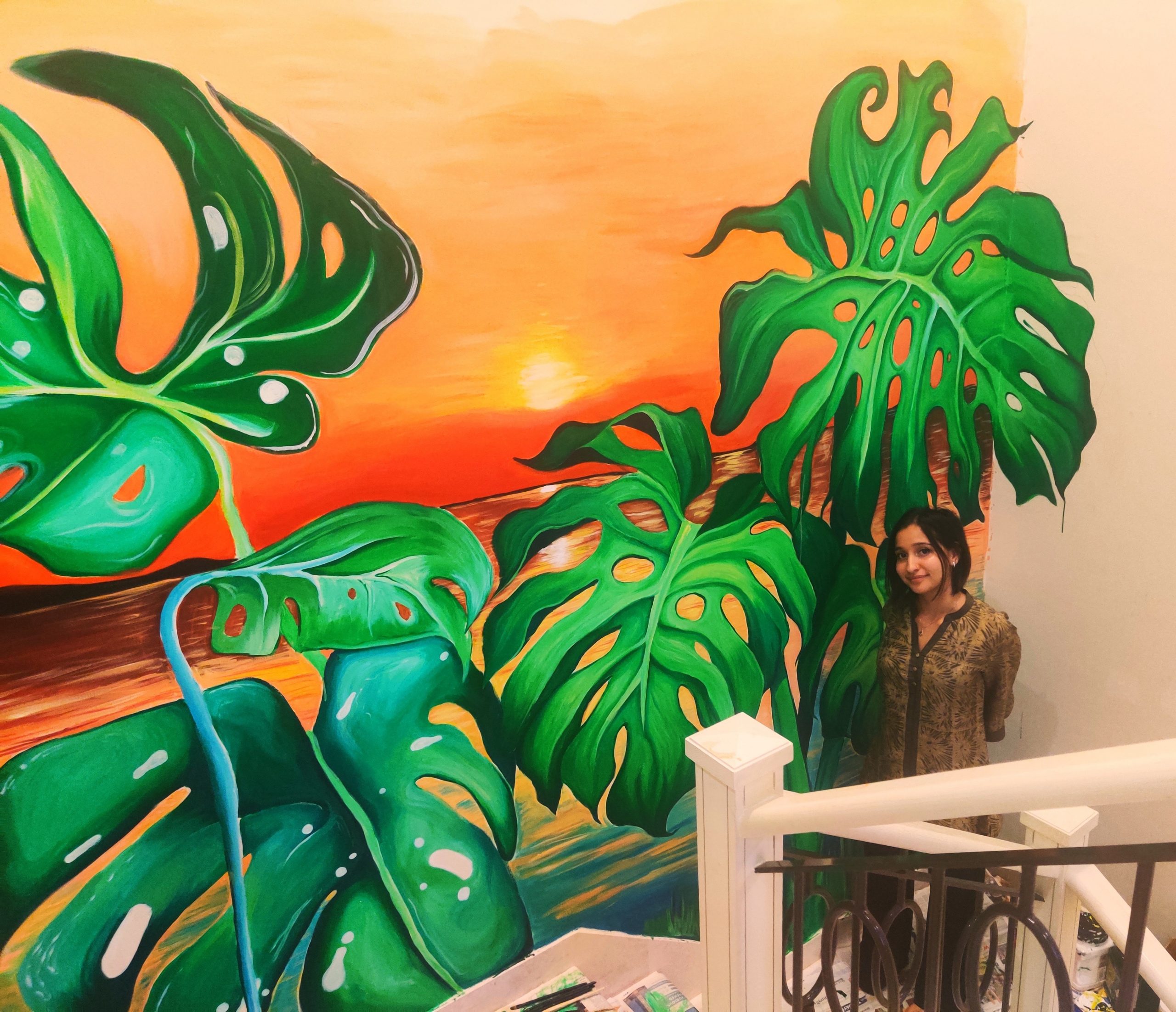
AA: No, honestly, I think I had a great time recovering, starting end of April. Because I was just in bed having nothing to do after so long. It was just me and Isabel. Isabel’s a poet. Us two on lockdown, there was so much to do. We had such a good time! I painted a big mural at my mom’s house. Honestly I started three paintings. They’re huge. I worked on a lot of music too. I made a whole poetry book, I didn’t even know I could write poetry. I’ve been recording songs for an album, hopefully coming out in December. So I feel like it was a good time to just do. You know to not think about all the other shit, because I was just trying to get better. So, it was like in that time I could just do my shit.
AP: And how were you feeling emotionally? I know physically you were drained, was it the same emotionally? Did you feel like you were going crazy a little?
AA: Yeah, honestly, it’s been a mixture of breakdowns and cheesing really hard. It’s been like happy then crying. I went through a really bad break up. Which I ended as soon as I got COVID. It was a really abusive relationship, so I used that period to heal from that as well. So I was emotionally really going to really bad to a lot stronger, you know because so much better without him. Yeah, it was … the struggle of financial stuff was really getting to me, family stuff. Yeah it’s been an emotional trip, for real.
AP: I’m sure. I like how you mentioned it was either bad or good. There was probably so much going through your brain. That’s another thing with COVID too, everyone had a life before, so how do we accept this new thing that’s impacting so many people and then go through our own school life, financial stuff, family stuff. It’s a lot of weight, confusion and stress. Did creating your artwork and overall creativity help you heal during and after COVID?
AA: Yeah, you see I really had to push myself to create. Just because I would start painting and then feel really drained after 15 minutes which I’m not used to. It was good in the sense that I had to push myself in a way you know, but I feel like without it maybe I wouldn’t have kept pushing myself.
AP: What about physically. Do you think pushing yourself to paint for longer, to keep going? Do you think it helped you heal in terms of getting your body moving?
AA: So I took a month break from painting and stuff. That’s when I made my poetry book. I think it was like a month and a half or something, because I could feel myself just growing more tired. I didn’t know if I was getting COVID again or what was going on. My fever was getting worst, I started to throw up again. Really, we don’t know anything about the virus so it’s hard to say.
AP: I meant to ask you this before, but do you have any underlying condition? Either that you feel comfortable sharing or that you know of.
AA: What do you mean, like physical or …?
AP: A lot of what we knew in the beginning of COVID is that it impacts intensely those who have diabetes or other health worries.
AA: I have pretty severe anemia. I get blood transfusions sometimes. It is a blood disease so I feel like that’s why it maybe affected me so badly.
AP: I mean, I didn’t know this story before. So hearing you speak about it, so much has happened in that small period of time, and your body was really tested. You know, to see you here today is really amazing. To know your body and mind could get through that.
AA: I feel like I’m saying it and hearing it for the first time.
AP: I remember you sent me that mural you made at your mom’s house, I guess. And I asked you to write a little about it, but it was until then that I even knew you had gone through COVID. And the piece that you created, I’m going to include it in this interview, was just beautiful. I think it goes to show, that creativity doesn’t just stop it kind of flows along as you do. Even if you needed that month break from painting there was the substitute poetry, and just finding ways to express yourself. Especially when you have a lot to express!
AP: You mentioned that you got tested in May and it came back positive. Maybe a few weeks later you got tested again and came back negative, but positive for antibodies. What was the process of that like? Were you going to the hospital to get tested or …?
AA: No. So what happened was, the hospitals were still pretty crowded here by May and I had gotten a little better. My mom’s a doctor, she kind of flew me out of here. So I went home and she treated me, got my tests done.
AP: What was it like getting treated in Pakistan?
AA: Yeah, I mean I would really only go in to get the test. There was one time I went to the hospital because I needed to get some tests done. Like my iron, I remember I was passing out, and my anemia was hitting. So I got a blood transfusion. But mainly my mom was treating me at home, with supplements and resting, a lot of resting and breathing exercises. Which was cool because you know, I felt like the more I was breathing, the more I was creating art. So I was like “Wow like I’m breathing art right now.” But yeah it’s a lot of resting, sleeping, eating. It’s like you’re a baby.
AP: I guess that makes sense because you’re at a very vulnerable state you know. That’s really beautiful that your mom could assist you in that way. Because I’m sure it’s a lot more comfortable than having a random stranger in a hospital poke at you.
AA: Yeah. I have a very complicated relationship with my mom. You know we fight a lot because we’re very different. I think the fact that she nearly lost me because I really thought I was going to die during COVID. Especially when I was alone, I was just like “This is it.” And she also thought I was going to die. So the fact that she almost lost me our relationship became a lot easier.
AP: What a beautiful outcome of a really terrible situation. Now your COVID free! You, of course, eventually tested negative. What were some of your thoughts at the point? Were you exhausted, relieved, confused?
AA: We were really happy. Then I could finally see my parents because before the test had come back I was staying in a room in my uncle’s house, which sucks because my uncle’s a misogynistic asshole. But it was fine because I was in a room and didn’t have to see anybody. But then we were excited because I could finally see my family, and you know I don’t have to feel like I have some crazy disease inside of me, eating me up. So, it was a great moment.
AP: And did you end up coming back to NYC after that? Were you unsure of what to do now?
AA: Honestly, Pakistan is going through it always. COVID got a lot worst there. It was bad, you would just look out of your window and there were people just dead on the street. So being there was not great for me, and they say that maybe you can get it again, and I couldn’t find any work there. My mental health was getting worse because of isolation and a lot of violence outside because everyone was going through it. Anybody who would go outside would get mugged, or you’d hear gunshots all the time. It was not a pleasant place to stay. So I convinced my parents to let me come back, I said “I’ll be fine” you know. But I think it’s a better decision to be here (NYC) at least for now.
AP: I’m 18 now so it’s more recent of a discovery that “Wow, I can truly make my own decision.” But you, now 21 you’ve been living your adult life. I think it’s really great that you know how to make and stick to it. It shows a lot about you. Even through the hardest things we’re presented with. I’m sure you took a lot from this experience, but is there one big lesson that you can think of? Is there something (positive/negative) that came out of this experience?
AA: Yeah for sure. Before I had COVID, I was very suicidal. And after I got it, you know and before Isabel came along, I was just about to give up. I was like “Shit happens,” but you really have to push yourself. And with COVID you really have to make yourself live. Because you have to keep forcing yourself to eat, and then throw it up. Drink water, throw it up. But none of that matters because you have to keep doing it. And for weeks, I was doing that all, for months. And it’s real because if you stop you will straight up die. It really showed me that I can do anything, lowkey! And just proving to myself that I really am strong. That I shouldn’t hate on the world so much. Because yeah, it’s a fucked up place, but there are perks. You can’t just give up sometimes when things suck.
AP: That’s a great take away. It’s interesting because you mentioned being suicidal before, and then coming face to face with an almost death experience. It could be empowering, which is not what you’d expect from such a crazy and hard time. Maybe try and elaborate, did you see any specific changes within yourself? Do you maybe sit up a different way, carry yourself different?
AA: Yeah, I feel like I’m just better alone. I think I’ve really learned to cherish my alone time. I’m more loving, less scared to love. You know Isabel and I had arguments. It was so much going back and forth with her and my parents. I feel like all of that has just gone to rest. I’m better with resting with what I have.
AP: That makes perfect sense. And in terms of creativity, do you think you have new things to paint about? New stories to tell? Do you think in anyway this experience altered the direction of your creativity?
AA: For sure. Before, a lot of my paintings were definitely darker. But now I’m really scared of that shit! I’ll look at my paintings and get frightened. I’m just not that person anymore. I’m not that dark anymore, I want to paint flowers! You know, beautiful nude ladies, just chilling with a blunt you know! That’s what I like to paint now, while before it was quite evil and dark. Even though there are similar elements in all my painting. Things have definitely changed.
AP: I guess I didn’t expect them to change that way. But it definitely makes sense! You really know the worth of living. And going away with that experience your life continues within your art, and within your paintings. That’s a beautiful reflection. What about DJing? Do you think you’re going to still do it?
AA: Yeah, it was my birthday last week…
AP: Happy belated birthday!
AA: Thank you! I had a little set. I’ve been doing live sets through Twitch TV. But I had my first live set on my birthday. I was so hyped, because I loved playing for people, and it was all my friends! And Sunday I’m doing a roof top one. We’ll see, it’s supposed to be a socially distanced event. But I’m excited to get back.
AP: I guess to end off our interview, I wanted to ask this last question. Do you think overall that your creativity and your painting was an important tool in your journey healing from COVID-19?
AA: Yeah, I think so. Your physical and mental are linked, and I feel like even if the creative process didn’t help me physically, it did mentally. And you have to be mentally strong to get physically strong. So I feel like it did, because without it I would be physically healthy but just depressed.
AP: I’m really excited to see all you continue to create, and the life you continue to live.