
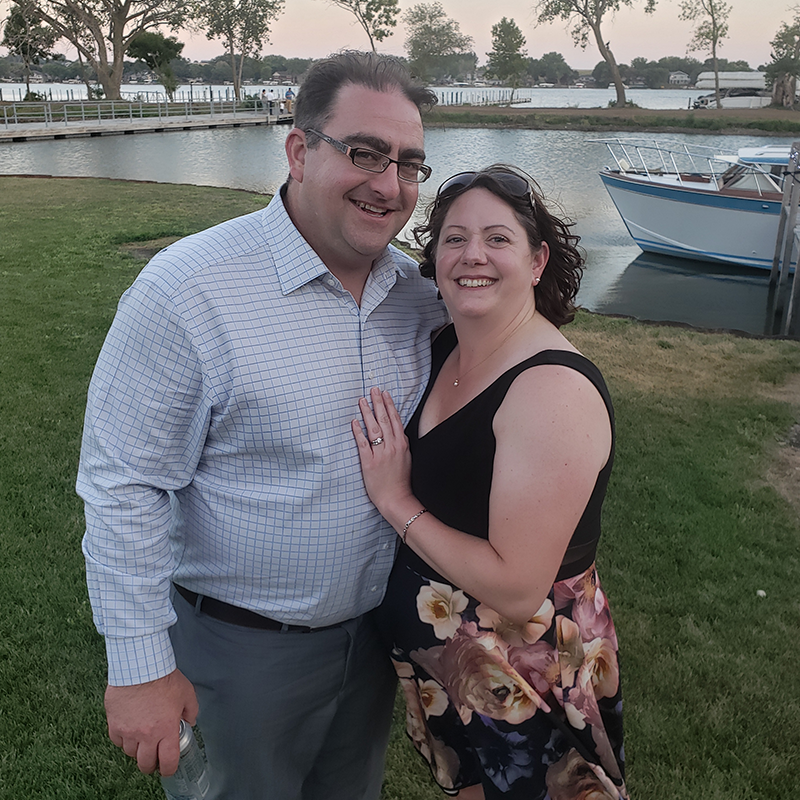
Heidi Stevermer with husband, Brad Stevermer
Interviewee: Heidi Stevermer, Blue Earth, MN
Interviewer: Katharine Davis, Amherst, MA
Date of Interview: October 6, 2020, Via Zoom
Subject: Medical Workers during COVID-19 Pandemic (March-October 2020)
Katharine Davis: Do I have permission to record your words and deposit this interview in the Hampshire College COVID-19 Oral History Archive?
Heidi Stevermer: Yes, you do.
KD: What year were you born?
HS: 1980.
KD: And where are you from?
HS: New Ulm, Minnesota, but I was born in Mankato, Minnesota.
KD: And what’s your occupation?
HS: I’m a nurse practitioner.
KD: And how many years have you been a nurse practitioner?
HS: I have been a nurse practitioner since 2014, so that puts me at six years now.
KD: Can you describe what being a nurse practitioner would involve during normal times?
HS: So, during normal times, I do family medicine. And so I see a lot of physicals and well-child visits, updating people’s vaccinations, doing sports physicals or managing medications. So kind of the whole gamut, but it ends up being a lot of wellness and medication renewals and physicals.
KD: Has any of that changed during the pandemic, and if so, how?
HS: Absolutely it has changed. So, in the Midwest, and I know it’s different with each region, but many places in the United States, of course sports activities and any extracurricular activities at the schools have been limited. So we have not seen … typically over the summer, we would see a large influx of people needing a sports participation exam, so making sure they’re healthy enough for their athletics. And with none of those being scheduled, or people being uncertain, we saw a big lag in that. We did have a few parents who brought people in to have that done, just trying to be ready because they weren’t sure how much notice they would have. So that was a little different as well, usually we don’t see that much of an advance preparedness, but people were just trying to be ready in case they went. But for the most part, we just didn’t see very many sports physicals.
HS: Also, most medical facilities were canceling elective procedures, so anything that was not an emergency and could wait at least a few more weeks or a few months was being canceled. So we didn’t have as many people needing to have a physical prior to a procedure. And then also, most of the places in the United States were discouraging people from coming into a clinic unless they absolutely had to, in general. So even medication refills and those types of things, we were trying to virtually, or just fill the medications for a little bit longer to avoid those visits.
KD: And what are your practice’s current safety and health protocols to prevent you and your patients from COVID?
HS: Sure. So, fairly standard, the symptom screening that pretty much any place has now. So, if anyone has a cough, fever, sore throat, has been exposed to COVID-19 or is in quarantine waiting for test results, we will do a virtual visit by phone or video, but we don’t want to see them in person because we don’t want to put any of our other patients at risk or ourselves. And then we in Minnesota, have a statewide mask mandate, so any indoor businesses you have to wear a mask. That was sort of our protocol prior to that mandate, just being a medical facility. Most healthcare-related facilities were requiring masks already, but now it is a state mandate.
KD: And have the guidelines changed at all since the beginning of the pandemic?
HS: Yes. I would say the biggest thing I’ve noticed changing is how to approach people that may have been exposed. Early on, I hadn’t quite transitioned to my new job location, so I was working with the Mayo Clinic, which is a large health care organization obviously, and is located in multiple states. So our protocols early on were much more restrictive, and with any question of an exposure, people were asked to stay home for two weeks, we just were uncertain. Now, I notice, there’s just a lot more guidance every time the guidelines update. There’s a lot more specific information about exactly what is considered a close exposure that would require quarantine. It’s certainly narrowed a lot, which has made it a lot easier for people. So we’re not just quarantining everybody in a location.
KD: And have you had any patients who have refused to follow those guidelines? And if so, how have you resolved the situation?
HS: Currently, I have not really had any patients refuse to follow the quarantine or COVID-specific guidelines. I guess the biggest thing would be, I had one patient I can think of that was coming in for severe anxiety, and so the mask thing was an issue. Not that he was trying to be abrasive, but that was a barrier for him to come in and be able to take care of his anxiety. And so we offered phone or video visits, or an option to come at an off time when we knew there would not be any other patients and we could do more deep cleaning after he left, and he was okay with those options.
KD: So you joined your current practice earlier this year, in April, correct?
HS: Yes.
KD: And did the virus interrupt or change any of your plans that you had made regarding switching practices?
HS: Yes. So it didn’t affect my decision to change, although it made it more stressful, with just the unknowns of what that would be, and some of the changes in business and what we were going to market as our services. But the biggest thing was supply chain issues. So a lot of the supplies we needed when I first talked with distributors, they told me that most things would arrive within three to four days of placing an order. And so we really couldn’t order early on, because our remodel for our clinic was not quite done and we would’ve had nowhere to store them and keep them safe without construction dust and things getting on them. So we waited to order. But by the time we had our remodeling project done, supply chains had really constricted quickly, and so then we could not receive most of those supplies.
KD: So then, what supplies were those, specifically?
HS: So specifically, we are still actually struggling to get swabs to collect a strep swab, so to test if somebody has strep throat, for example. And part of that is any sort of collection swab for any bacteria or virus was placed on a hold with most companies, and then there were actually some federal holds as well for a while, because they were trying to conserve those for COVID testing. But then even other things like exam equipment, exam tables, so the furniture in the exam rooms, was just a much greater lead time. Those took- they were supposed to take a couple of weeks and I think it took close to two months to get those refurbished at a facility and get them back, because many places just weren’t doing anything, they had shut down a lot of the factory settings.
KD: So then how did you work around the difficulty of not having those necessary supplies?
HS: So, we started our exam room with just a couple of chairs. We were able to find some massage tables that weren’t being used, that we could borrow from people. And then we just let our patients know the situation, and most people were pretty accepting of it. By that time I think most people had encountered other disruptions in their life as well, so they were pretty understanding that it was out of our control.
KD: So you practice in rural Minnesota, correct?
HS: Yes, that’s correct.
KD: And how has that specifically shaped your experiences during the pandemic?
HS: It’s been interesting, I feel like when I’ve spoken with other healthcare professionals, they say that their telehealth has really taken off, that that’s been very popular, and we have found quite the opposite. We’ve offered that first to everybody, but we’ve found a lot of people don’t want to do a telehealth visit in rural Minnesota. And I’m not quite sure if that’s related to less available Internet, or poor connection, or if it’s just comfort level, it’s been hard to pinpoint. But that’s been a major difference in rural Minnesota.
KD: So from the point of view of being a nurse practitioner, do you think your experience with the pandemic differs from other people’s, and if so, how?
HS: I think so. I think early on, we were receiving through the Board of Nursing and through CDC and Department of Health email chains that we’re just kind of automatically on, through our licensing bodies and things, I think we were just getting information a lot earlier than the general public. So I think there was maybe more fear amongst healthcare providers earlier than the general public. When most people were probably thinking it wasn’t really a risk to us yet, or wasn’t here yet, we hadn’t heard much about it, we were hearing about that earlier. So I think that certainly changes things. Also I think just more of a chance of knowing someone who has seen somebody very ill. Because I know a lot of healthcare providers, so seeing just more of a serious view of it than the general public.
KD: And has working as a medical professional during the pandemic affected your home life and your children in any way? And if so, how?
HS: I would say so. I think I’m just a lot more concerned about bringing things home with me, and infecting my family. Also, it’s certainly affected our household, as far as having to figure out if one of our children is showing signs of potential illness, how we’re going to manage that, because I certainly don’t want to make any of my patients ill either. And if someone is coming to see me, the chances are that they might have a medical condition. So they may be at higher risk. So I think that’s just made the decision-making on a day-to-day basis a lot tougher, just knowing when to be concerned and what precautions to take.
KD: So we’ve talked about a lot so far. Is there anything you want to add or clarify or maybe something we skimmed over that you want to talk more about?
HS: Yes. I guess one of the things I forgot to mention, when we were talking about supplies is, and I just think this’ll be interesting for future generations to hear. We were unable to get any supply that had any agent in it that they thought could be effective against killing COVID-19. So anything that had any alcohol component at all was kind of on a lock-down of its own. We couldn’t order, we couldn’t access it. You know as an individual, just getting hand sanitizer, that’s something that probably many people will remember. But even simple things that we needed to start our lab – we couldn’t get the small alcohol swabs just to wipe a finger before checking a blood sugar. Even when we found the right kind of hand sanitizer for our dispensers, the price was almost quadruple what it normally would be. And so that really changed our budget, and just our ability to be able to take care of patients.
KD: Is there anything else?
HS: I think being in a rural setting, probably was a little bit different scenario, because we were not the big contracts with distributors. And also, we don’t have the resources to develop our own COVID testing like some of the bigger healthcare organizations, and so they were able to have priority to get medical supplies, because they were researching treatments and testing options. And so I think that we were at a little bit of a disadvantage in that way. But the advantage was, I think, people trusted coming to a small facility more, because they didn’t feel like they would be in a waiting room with a hundred people that could potentially be infectious. So a little bit of give-and-take.
KD: Great. Any last things that you’d like to add?
HS: Nothing else I can think of.
KD: Great. Thank you for this interview. I’m going to stop recording, but you should wait right here and I will be right back.
HS: Okay.