
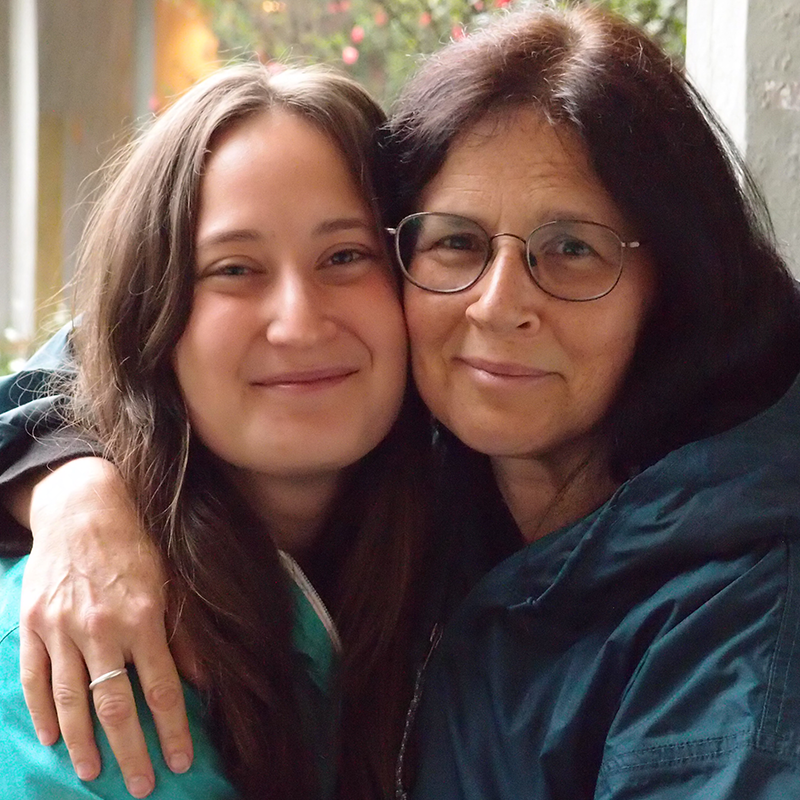
Lisa Alcott (right) with her daughter, Suzannah Hershey.
Interviewee: Lisa Alcott, Cold Springs, NY
Interviewed by Becky Miller, Amherst, MA
Date: August 19, 2020, Via Zoom
Topic: Medical Workers on the Frontline
Becky Miller: So, could you start by giving me your full name and what year you were born and where you live?
Lisa Alcott: Yes, my name is Lisa Alcott and I was born in 1958. And I live in Cold Spring, New York, in the Hudson Valley.
Becky Miller: Can you tell me a little bit about your job? What your job title is and what you do and where you work?
Lisa Alcott: Yes. I am a pediatric nurse practitioner. And I work in the Pediatric Emergency Room of North Central Bronx Hospital, which is a public hospital in New York City. I’ve been at this job for 29 years. And in the occupation, in general, for 35 years.
Becky Miller: Great. I just want to ask you to give permission for me to record this interview for inclusion in the Hampshire College Oral History Archive.
Lisa Alcott: Sure. That’s fine. Yes. I give you permission.
Becky Miller: Thank you very much. Okay. So, you’ve been at the hospital for 29 years. Can you talk a little bit about what your responsibilities there were before the pandemic and … then after the pandemic, since the pandemic set in?
Lisa Alcott: You know, I take care of kids who come into the Pediatric ER. I mean, essentially, I’m, functionally really I’m working as a pediatrician as all the other nurse practitioners do also. So our age group until a couple of years ago, went up to age 18 and then a couple of years ago was shifted to 21. And then during, you know, as most people know, we had a huge COVID surge in New York, in March, April, May.
Lisa Alcott: But the pediatric population was the least affected. And so, and meanwhile, any kid who didn’t have COVID, the families were afraid to bring them in for any of the things they usually bring them in for so. So we expanded our age range up to age 30 and sometimes older. I did see a few people up to even age 40 because we were trying to take some of the burden off the adult ER. So, but somewhat awhile after it all kind of died down again, we went back to our usual age range up to age 21.
Becky Miller: And when you say that you were seeing patients up to 40 years old, were these people who were suffering from symptoms of COVID-19?
Lisa Alcott: Yeah, most of them, most of them were because at that … there was a stretch of time when it seemed that nobody came in for any other reason except COVID or could be COVID. And, although the people in the age group that we saw tended not to be the sickest ones. And I had a couple of different young men in their twenties who I almost admitted to the hospital, but who kind of rallied somewhat at the last minute and were able to go home. So and the rest were not as sick or occasionally they were coming in for other reasons, but almost everybody was coming in for COVID. At that point, we weren’t testing them unless we were going to admit them because of the shortage of testing supplies and all of that.
Lisa Alcott: But they were pretty much without question in COVID, almost all of them. So, but as I said, most of the young and young middle aged ones were walking and talking and maintaining enough of a normal oxygen level to take care of themselves at home.
Becky Miller: So what was your advice to them? I mean, what could you do for them when they came in?
Lisa Alcott: Well, you know, it was hard because, you know, people came in also at different stages of their illness, but the hard part then was that there was often a fine line and a very short transition period from being stable enough to stay home and sick enough that you had to be in the hospital. And people really often couldn’t tell the difference. And, you know, after that, there was more sort of publicity in the press and things about the desirability of having a little gadget called a pulse oximeter at home, and you can check your own oxygen level, but, nobody had those and they became very hard to get.
Lisa Alcott: And sometimes that’s the thing you may, they weren’t always going to recognize that they were much sicker, but meanwhile, their oxygen levels might be dropping a lot. So, you know, it was a little hard. Like people would come in and they would say they felt short of breath, but objectively like as far as their lungs and sometimes their chest X rays and their oxygen levels, they were okay to go home. But you can’t really say to somebody well, come back if you feel short of breath, if they’ve already told you, they feel short of breath and you’re sending them home. So that was a little iffy, you know, you kind of just had to say, okay, if you feel any worse, and, you don’t always, … You know, it felt often very insecure telling people now, like, how are they supposed to know? So, I know that was a conundrum for people taking care of the older patients as well. There wasn’t enough hospital space to admit everybody you might want to admit, but you never knew if they were going to go home and just suddenly crash.
Becky Miller: So there was a surge in New York, if I remember correctly, at the end of March into April, right?
Lisa Alcott: Yeah.
Becky Miller: Where many, many, many people presented with symptoms of COVID …
Lisa Alcott: Yeah.
Becky Miller: At the height of that surge, would that have been like in the mid April, late April? Is that accurate?
Lisa Alcott: Well, it was earlier, I think. It’s hard to remember now, but I think it started maybe the very beginning of April or before. And like the adult Emergency Room was really kind of apocalyptic. There were people, you know, on ventilators in three or four different rooms. People dying in the ER. The wards, the Intensive Care Unit filled up. They opened up a bunch of like, sort of repurposed Intensive Care Units. And people were also being transferred from other hospitals all over the city that will be overwhelmed. And we even, in our ER, there’s a room that used to be used with sort of the sicker adult patients. It was just a big long room with about eight or nine stretchers. And that was actually converted or just used as an inpatient ICU, still with the stretchers, still no rooms.
Lisa Alcott: And then we have lots of temporary staff from all over. And the place looked like a Red Cross shelter after a hurricane. But there were people on ventilators in every bed in this room. Some of us from pediatrics also, because we didn’t have the high patient volume that the Adult ER had, we started going around the wards with iPads so that the patient’s families could video call them. And we would spend, I would spend hours every day doing this. And the calls were mostly by appointment. There was an office that the families would call to set them up. But, sometimes you will also get like an emergency call from the administrator saying, basically somebody is about to die. Can you go, can you go up there so the family can say goodbye to them. And the ones, even with the appointments more than especially the first couple of weeks, maybe three quarters of the patients whose families wanted to talk to them were actually in critical care on ventilators, sedated and completely unresponsive.
Lisa Alcott: And you never knew if they even heard anything or not, but the families could see them and talk to them. And then the ones who were not in critical care, some of them also were really too sick to participate much in these conversations. But they might, you know, they were a little more aware. So, it was, ah, you know, that was pretty terrible. I mean, it was beautiful to be able to do it. And for some of these people, especially, you know, maybe things are a little better now, but in the early stages, like in medical terms, really, nobody knew what to do. So everybody was getting treated with whatever anybody could think of, but the ones who got sick enough to be in the ICU, most of them died. And so that, you know, whatever little bit of human contact you could manage with them, or for them was almost the only meaningful thing that you could do.
Lisa Alcott: One thing that really made an impression on me … I mean the ICU staff, and again, a lot of people that come in from all over the country like agency nurses and volunteer doctors and respiratory therapists and what have you and there were people from everywhere and people from the Navy. And they really were so committed. And, they really took it so personally. … I’d come in and say, Oh, I have … an appointment for a video call with so and so, you know, is it okay to go in? And, … the doctor would say, yeah, let me just fix him up a little first. And let go in and adjust the gown and comb the person’s hair, you know, not want them to look so frightening.
Becky Miller: Obviously this couldn’t have been easy. I don’t want to assume anything, but I’m just thinking as a nurse with a iPad, helping a family communicate with a loved one’s last minutes. I mean, I wonder what kind of, emotional toll it may have taken on you. That couldn’t have been easy.
Lisa Alcott: Well … it was … it wasn’t and the family, I mean, you know, some of these were very emotional and an almost hysterical way from the families and some of them were … there was a lot of praying. There were a lot of families with like groups or contacting other. And they were almost always incredibly appreciative of being able to communicate in any way. And … really, these people who were so devastated and still take the time to like, you know, to thank us really in the most heartfelt way. But … the strange thing was it, you know ….
Lisa Alcott: With the patients, I had never met any of them when they were conscious. The ones in intensive care. And so it’s very, you know, I’d find I would go home and like see them in my sleep and kind of, I can remember all their names, but they were, um, I … It was hard to recognize them as people. Like you could see through the lens of the family’s communication with them. And a couple of times there was some families that we called to ask them for sort of biographical information about their person. So we can write it down and put it on the bed and, you know, things like that. But, yeah, it, I mean, I’m good at compartmentalizing and I did, and I still do, but, but I mean, it was kind of nightmarish and one of the last minute, … the, you know, impending death phone calls were the minority.
Lisa Alcott: Sometimes we went to see the same people over and over, you know, because their families wanted to talk to them at a date or a different relative wanted to. … But one of the emergency calls, one of our Pediatric ER nurses, …her mother, brother, and father all got COVID and her mother and brother did okay. But her father who was maybe 68 wound up in the hospital and got sicker and sicker, and then he died and … I got a call asking if I could go up there for him because he was dying. And this is someone I know. And I mean, I don’t, I didn’t know him, but I know the daughter. I’m very fond of her. And they were actually, when I got there, they were actually trying to resuscitate her dad. I mean, he was already hooked up to everything imaginable, but they were trying to tweak him to keep him going longer.
Lisa Alcott: And at first I couldn’t even get near him. Then I had her and her mom and her brother all on the phone, you know, kind of aware of all this. And I was saying, okay, as soon as, as soon as I can get to the bed and you can see his face. And then … that was someone that was very personal obviously. ‘Cause it was a friend. And he did actually want to, he hung on for about one more day after that, although not in any meaningful way. But yeah, …I mean, those are my, in a way, my most intense memories of the whole thing. I shouldn’t, you know, it’s the same memories I’m going … really come roaring back again at any moment. So it might not be memories for much longer. They might be current reality again, but you know, right now things are better now.
Becky Miller: I just wonder if you can give me an example, if you can think of a moment when the real dimensions of this crisis, of this pandemic, crystallized for you as a medical practitioner. Like, was there a moment, you know, when suddenly it became clear to you that this was …this was what it was: a crisis. I just wonder if that that happened and how you’d describe it.
Lisa Alcott: … I don’t know if there was an exact moment, but I do remember that back when the surge really started, like, you know, the ER was suddenly full of people in what looked like space suits. I mean, unrecognizably so, and the, you know, patients being intubated everywhere. And at the same time, my, that was at the same time that my own brother got sick and wound up hospitalized. And I often … you know, I’d be away … seeing a patient or making the phone calls and would come back and find out that his doctors have been trying to get in touch with me just to give me an update. … I don’t think there was an exact moment, but there was certainly a period of weeks where it was kind of all overwhelming all the time.
Becky Miller: Were you asked to work overtime during the real surge?
Lisa Alcott: No, because, as I said, there were people … I don’t think anyone was asked to work overtime, but they did have this huge amount of supplemental staff. I mean, a vast number of people came to work in New York. … And some of them … you know, the other thing, a lot of people were either drafted or sort of propelled to do things that they probably really had no idea how to do. I mean, it was literally true that like gynecologists were on call to like run the ICU. And I think the, a lot of us in pediatrics felt like, you know, we would go anywhere and do anything that we are capable of doing. But, you know, we don’t want to be some [in the middle?] or we’re going to start killing people even faster. So they really didn’t need us to work overtime. But as I said, there were probably hundreds of people who came in to do like three weeks stints or whatever. And those people were like the nurses who came in from agencies, I think they signed up for 21 days and they only had two days off all the time.
Lisa Alcott: They signed up for that and they were well-paid and all of that, but that’s, that was the deal. They worked 12 hour days for 19 out of 21.
Becky Miller:There’s a lot of …coverage by the media about the lack of PPE — personal protective equipment — in hospitals. In retrospect, was your hospital prepared for the number of patients?
Lisa Alcott: I mean, no, in the sense that … Take, for instance, the N-95 masks we were told to reuse for, at various times either five shifts or three shifts. And, you know, normally those are like a single encounter and you throw them away. So …and face shields also, I mean, I’m some of this stuff there’s more available now, but I …know a lot of departments ran out of face shields and I had a friend who was making them and I use the ones that she made. And things like goggles. I think at first they were giving out, but then if you wanted them, you had to get your own.
Lisa Alcott: So yeah, there were, there were a lot of problems with PPE. … You know, they would say, we’re fine, we have everything, but it’s sort of like, we have everything if we’re using it under these, these sort of brand new parameters that you probably would’ve gotten, you know, killed by the Infection Control Committee, if you had tried doing this earlier. But, but that’s what we were doing. I mean, I don’t remember ever running out of things like gloves. We seemed to always have those.
Becky Miller: I remember reading on your Facebook page … One of your colleagues is from, I think, somewhere in West Africa, I’m forgetting precisely where. And she sewed a bunch of beautiful face masks that she…
Lisa Alcott: Oh, ok. …we have millions of people working in the ER from Ghana, particularly.
Lisa Alcott: I mean, from lots of other places, but there’s a big contingent from Ghana. So one of the Adult ER nurses and one of the Patient Care Techs, also, they have a friend who is a seamstress for a lot of the Ghanaian community in the Bronx. And I guess normally she makes a lot of like things that people wear to weddings or church or when they want to get dressed up. And so for awhile, nobody was doing that. So she started making caps. And right around the time that the hospital ran out of hairnets, the nurse came in with a bag full of these caps and people fell on her like starving animals. (Laughs) And she had sold these things out in minutes and she’s brought others back since then. And people have made custom orders and the hats are still everywhere.
Lisa Alcott: And they’re also … you know, they’re kind of a cheering up fashion statement now because otherwise everybody looks the same. So, but everybody’s got something fancy on their heads. You know, even people with no hair are wearing them.
Becky Miller: I mean, just the images and the photos. They’re very, it’s very colorful. (Yeah!) You know, specific to West Africa, they’re very colorful, lots of different patterns and.
Lisa Alcott: Yeah.
Becky Miller: Like incredibly, um, jolly in the face of …
Lisa Alcott: Yeah, it’s very festive. And … I think that actually means something like, I don’t know how much the people coming in care about it, but I think to see something which, ah, to see something that looks festive and cheery like that and that where … everybody doesn’t look exactly the same, even though of course now a lot of us are wearing the exact same hats (laughs)! So! (Laughs.)
Lisa Alcott: But I think that … people like it and actually it also helps them tell us apart. It helps us tell each other apart, you know, sometimes you can barely recognize the person with all this gear on even if you know them.
Becky Miller: All right. … This is sort of shifting topic here, but, I just wonder, you’re in a peculiar situation because normally you work with children as a pediatric [nurse].
Lisa Alcott: Yeah.
Becky Miller: Just out of curiosity, I don’t know if you can answer this, but, how did your relationship and your interactions with patients shift, with the onslaught of this pandemic?
Lisa Alcott: Well, the thing that shifted is that, it’s, you know, you can’t, or most of the time you shouldn’t get so close to people anymore, plus you have all these barriers on.
Lisa Alcott: And so, you know, I would still try to go in, sit down, and have the same kind of conversation that I would have had before. But … you know, you’re trying to keep your distance. You’re trying to only touch people when you really have to. And of course, this is all about touching people. And with the kids, well, as I said, a lot of of our patients shifted towards the older ones or really older teenagers while this was happening, but there are still some of the small ones. You know, the kids it’s like, you kind of, your instinct is to sort of, you know, put your arm around them and hug them. And you know, hug the mother if she’s having a breakdown. Whatever, and you know, I think we’ve all still done that, but not as much.
Lisa Alcott: But, one thing. … every time you go into the room, you have to put all this stuff on first. And then if you go out and want to go in, again, you find yourself not doing that as often, just because you have to get dressed. And it does make more of a distance. But I think, I’m noticing lately, especially it’s… not so bad. Like I’m surprised at how even the little kids seem not to be scared of when someone coming in, looking like a Martian. You know, just most of them are. And some, they still respond the same way that they did before. And you still you’d give them a sticker and they don’t care if you’re wearing a face shield or not. With the…other ones, I … had one 19 year old girl who was in a very complicated life situation and had been very isolated because of COVID and other things. And anyway, whatever. She came in with a rather bizarre list of symptoms, which really did turn out all to be anxiety related. And when she was about to leave, I said, look, we’re not supposed to do this, but I’m going to give you a hug. And she said, Oh God, I haven’t had one in about four months (laughs).
Lisa Alcott: It’s like, yeah, I know.
(Talking over each other).
Becky Miller: So along those lines …if there was a fulfilling or gratifying moment or set of circumstances, given the context … Let me, let me phrase this differently. Was there, were there moments where you felt, you know, you were gratified about something that happened or you felt like something positive happened? That … you made somebody happy, that it was something positive?
Lisa Alcott: Well, there always are. I mean… with the people who came in that I, you know, saw it in the traditional ways as patients. … You know, there was always some way to make a connection and, kind of, we’re all in this with you. And at the end, with the families of the really sick patients, like the ones I did the FaceTime calls with, there was … really was a connection with the family. And like I said, sometimes it was the same people again. And like the people that I called to ask them to tell me, like, what was your wife or your mother or whatever, what is she like? Like, (unclear). You know, those were very sweet and gratifying also. And also I have to say … I work with mostly a really wonderful bunch of people. And the, I think the sense of solidarity and family, kind of, has been getting all of us through this.
Lisa Alcott: So I think for most, you know, it’s not like this everywhere, but a lot of people have said this for whatever reason about the hospital I work at, is that it is like that most of the time. And it’s kind of my home away from home. And it’s like that for a lot of other people too. So, you know, even when things were very bad, you could, you know, you could rely on your coworkers. And then there were all the things like we were … getting tons of donated food and all this stuff. I mean, it was being showered on us and, you know, it’s … it was sweet!
Becky Miller: I can, well imagine. Yeah. So, your family away from family. Speaking of, how did your work and the crisis of the surge impact your home life and your family?
Lisa Alcott: Well, yeah, you know, we’ve had to do a lot of physical distancing at home too, cause I was like Typhoid Mary, you know. … We’re all trying to …And then, my older daughter who was working in Mexico, came home at very short notice because we were afraid there would be a global lockdown and she’d be, you know, sick or quarantined there. So, now she’s been back, she’s been back at home. And you know, I guess it’s, you know, even though things now are, you know, COVID-wise at work, you know, are pretty low key, there still the general sense of, you know, being in a high risk job.
Becky Miller: So you still have to maintain social distance at home. Is that what you’re saying?
Lisa Alcott:Well, you know, probably not as diligent about it, but trying.
Becky Miller: Wow.
Lisa Alcott: Yeah.
Becky Miller: We’re kind of nearing the end of our time and we’re also both breaking up here. My internet connection seems to be unstable, so, … but I do have one question. You know, we’ve talked about a number of things and, indeed probably given short shrift to many of them. I just wonder if there’s anything that we talked about that you might want to, we kind of skimped over and you might want to add some detail or maybe there’s something that we didn’t talk about that feels important. If you’d like to add anything now would be great.
Lisa Alcott: The only thing I can think of is that when … I hear people …especially people, I know a little (thankfully there are not too many of them) who are kind of consuming conspiracy theories or just blowing the whole thing off and claiming it either doesn’t exist or, you know. I, I really take that personally, but I, I mean, I don’t feel like there’s much I can do about it, you know, once in a while I’ve said, okay, look, you know, I’m not going to watch your video because it’s like, it’s like, it’s like, who am I going to believe? You or my lying eyes? (Laughs)
Lisa Alcott: So, you know, … don’t give me that shit basically. But, I mean, there are many people personally, untouched or living in areas that have been blessedly, you know, relatively safe or whatever, and completely, completely don’t get it. I mean, the one person I know who said to somebody else, well from, you know, from where I am, nobody is sick. And I was thinking, you know … I can count at least 40 people I know who have been sick. And, you know, even if two thirds or three quarters of those are people I know from work, I mean the rest are not. And if I then add in like their family members, people I don’t know personally, but, you know, live with people I know personally, then if the numbers are even higher. So, you know, I don’t really want to hear people say that this is not real or that it’s exaggerated.
Becky Miller: I can imagine. That would make me crazy.
Lisa Alcott: Yeah.
Becky Miller: So actually another quick question, sorry, Lisa. …Does it strike you that a number of your colleagues at work actually did get sick? Or, I mean, is it a small percentage?
Lisa Alcott: Yeah, I think at least … 25 or 30 of them. And the age range was, the age range started at like maybe age 30 and went up to wherever. And the outcomes ranged from, you know, just mild illness to death, actually. And with most of them being in the middle, like either, either an icky, horrible illness but at home or for a few of them, a hospitalization, but not a critical one. But, yeah, there were a lot of them. … I think …probably a lot of people were exposed or infected before it became clear how much we had to protect ourselves.
Lisa Alcott: You know, it was more early on. And we had probably been seeing people with COVID kind of before we even knew what was going on. So then a few weeks later, people started getting sick, but, yeah, and the rest, I can’t, you know, obviously I can’t though … Those of us who have not been sick, you know, have sometimes said, okay, why haven’t we? You know, is this just sheer luck? Is it just timing? And we’re going to get sick later or is something protecting some people? I mean, we don’t know. You know, when they started encouraging the staff to get tested and to get tested for antibodies, that one day about seven of us from pediatrics all went and got antibody testing at once. It was like April. And, we couldn’t muster up a single antibody among us. And we were a little miffed! (Laughs) It’s like “What?!” And people who we knew had been sick had antibodies, but we figured at least some of us would have picked, had like a silence infection. And, nope.
Becky Miller: Not a single antibody among any of you?
Lisa Alcott: Not that I know of. Pathetic, right? So. Well, at least as of then … (Talking over each other.) … No, that was four months ago so things may have changed. I’m sorry. You were breaking up too.
Becky Miller: Have you been tested for COVID since?
Lisa Alcott: No, I haven’t been tested again, although they’ve now said, they’re sort of encouraging us now to get tested every month. And I’m actually gonna go tomorrow, but, there hasn’t seemed to be much point, in a way? So, and for a while, I’m not even actually what the official line is on this now. When they started making testing readily available to the staff, they said if you test positive, but you’re asymptomatic, just put on your PPE and come to work anyway. I guess, ’cause they were afraid at that point that if everybody who tested positive stayed home, ….they wouldn’t have any staff. I mean, we were very busy then. So now that things are slower, I’m actually not sure if that’s still the case or if we would be told to stay home for two weeks or whatever. So yeah, I know. Right. It sounds crazy.
Becky Miller: Okay. Well, we have definitely come to the end of our time and I want to thank you for doing this interview and …
Lisa Alcott: You’re welcome!
Becky Miller: If youwait one second, I’m just going to turn off the recording and I’ll come back. Okay.