
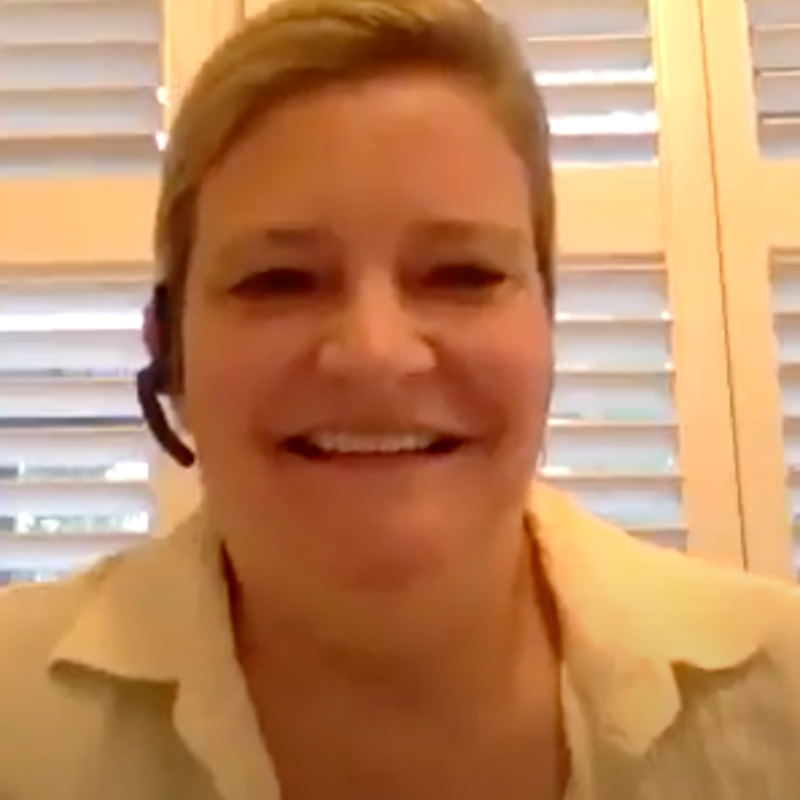
Interviewed by Flora Smith on October 9, 2020
Flora Smith: This is Flora Smith. Today is October 9th at 3:30 in 2020. I am interviewing Laura Good-Devereaux. That’s (spells Laura’s name) for the Hampshire College COVID-19 Oral History Archive. This interview is taking place over Zoom. This interview is sponsored by Hampshire College and is part of the First Year Seminar, Pandemics.
Flora Smith: Let’s start with some basics. Where are you currently? What are your preferred pronouns, first of all?
Laura Good-Devereaux: Yeah, thank you. Flora, and this sounds like such an exciting thing that Hampshire is doing. It’s wonderful. So everything is going to go into like an oral archive that all first year students are doing? That’s so neat. So I’m in Atlanta, Georgia, right now, just east of Atlanta. Basically very close to downtown Atlanta.
Flora Smith: And for note, I am currently in Amherst, Massachusetts, at Hampshire College. Could I please have your permission to record your interviews and deposit it in the Hampshire College Covid-19 Oral History Archive?
Laura Good-Devereaux: You absolutely can.
Flora Smith: Thank you
Laura Good-Devereaux: You’re welcome.
Flora Smith: So, where were you born? Where are you from?
Laura Good-Devereaux: So, I was born in Stuttgart, Germany, in 1964. And my father was German and my mother French, so I was born over there. And lived over there, actually, in a hospital for the first few years of my life cause I was born a very sick, sick little kid with lungs that weren’t fully developed. And so we lived over there until my mom became so desperate to get me some good medical care that we hopped on a ship and came and moved to Atlanta. And yeah, so I was sort of raised in Atlanta. We had a home in Washington, D.C, during most of my childhood that we moved back and forth to because my step-father was a Congressman at the time.
Flora Smith: What’s your current occupation?
Laura Good-Devereaux: So, I right now am kind of in the process of making a bit of a career change. I am founding my own consultancy, working to provide a service that doesn’t really exist anywhere in the country right now. And that is … when a child gets diagnosed with a health condition or learning disability or neuro-developmental condition, such as autism, parents are … the way that usually goes is the parents are given the diagnosis and they’re kind of just left standing there thinking “What now?” And my professional background and educational background have uniquely prepared me to work with these families around a whole set of issues. Kind of like planning for children with these kinds of issues: helping them with IEPs with their schools, helping them get the services they need healthcare-wise, and working with them in a counseling type capacity. So, that’s what I’m in the process of doing.
Flora Smith: My next question was going to be how long have you had said occupation, but since you’re just starting this up, I guess I will replace that with: what is your career background?
Laura Good Devereaux: The large majority of my career has been spent actually advising two Presidents and then a Congressional Committee, The Ways and Means Committee of the US House of Representatives. I advised President Clinton and President Barack Obama on a whole set of domestic policy issues. My expertise is in all legislative and public policy areas that affect children. So, everything from health care to child care to education to tax policy that affects children, and I particularly have been focused on policy that affects low income children. So I’ve done that. I’ve also run state government agencies. I founded a for-profit social/entrepreneurial company. And run a nonprofit. And, also I’ve been a college professor. Sort of had my feet in a lot of things.
Flora Smith: That’s very exciting. And I’ve heard, I could be wrong, that you’re applying for a job at the CDC as well?
Laura Good-Devereaux: Yeah, I am, though I don’t think that’s going to work out. Primarily because, and this is not necessarily related to your interview, I have a pretty significant back injury right now. And the CDC position would actually require me to have been traveling a week ago Monday. So, that’s not going to work out for right now, but it may be something if my own consultancy doesn’t get off the ground, that I may be pursuing again.
Flora Smith: Fantastic, thank you so much. How has the pandemic affected your professional life?
Laura Good-Devereaux: Ah, boy. So, I was actually teaching at Georgia State and doing consulting work for a part of Georgia State called Safe Care, which is a national program which is used to prevent abuse and neglect of children. So, I was consulting for them and teaching in the School of Public Health when the pandemic hit. And it pretty much, it ended … the classes that I was teaching and the consulting work that I was doing for the School of Public Health at Georgia State. Right now … it’s actually given me the time to sit back and reflect on what I want to do next. So, while it’s negative in the sense that it’s affected me in losing the work I was doing at the time, it’s also given me an opportunity to sit back and kind of think about what do I want to do … next.
Flora Smith: Okay. Quickly going back to applying to The Center for Disease Control. I was wondering, did you do that because of Covid or was that a part of your professional trajectory?
Laura Good-Devereaux: Yeah, so the role that I was applying for there was very much more a part of my professional trajectory. It was not a Covid related position. However it, like everything else in the world right now, was being dramatically affected by Covid. So, the role that I was applying for … CDC is divided up, the whole organization is divided up into four divisions and the division that I was applying for was a Deputy Director position for the Division of Injury Prevention. And falling under that is everything from prevention of child abuse and neglect to domestic violence to prevention [*coughs* pardon me] to prevention of things like drownings all over the world and prevention of opioid overdoses. So anything that you can kind of put within the spectrum of injury that is not disease related. So yes, it was a natural, natural part of my professional trajectory rather than being Covid related. But it was very affected by Covid because of the nature of the work I would be doing in the position. And the safety of doing that work. It would really not be safe for me, or safe, given the fact that I have a kid who’s got an immune deficiency.
Flora Smith: Since you were applying for this job, did it affect at all your work with special education, as you were mentioning before? Did it go well with, or did it have anything to do with, each other at all?
Laura Good-Devereaux: On the end of special education, not directly although many of the the overlap there would be that many of um, as you probably would suspect, many of the children who- not, this is not across the board, but many children who grow up with traumatic situations end up requiring special education. And oftentimes, don’t get the best special education at all and so the opportunity to work at a national level on prevention with some really neat programs that they are doing that are very effective are going to be exciting, but not a direct link with special education in that capacity.
Flora Smith: As someone who has experience in government, what is your opinion about how the Georgia State administration is handling the pandemic?
Laura Good-Devereaux: So this is a tough one to answer because I have extraordinarily strong feelings about it and it’s difficult for me to stay, kind of removed [*laughs*] in the sense of giving much of a balanced answer. I would have to say that, honestly I believe that Georgia has … handled it, if not the poorest, then within the top five poorest of all, all states right now. Unfortunately, because of the politicization of Covid and of all the issue surrounding Covid such as wearing masks and social distancing, we have an administration right now, which you know, coming from Georgia, really does not believe that it is the role of the government to impose any sort of restrictions on the population. Although, when you sort of broaden that lens a little bit, one would have to ask the leaders of our state right now, “Well do you believe it’s not appropriate to impose things such as restrictions saying you have to have automobile insurance to drive a car, you have to have a license to drive a car, that children must go to school up to age blank…up to age sixteen?” So, we have handled it very poorly and we would be in a very different place in our state if we had handled this better. I’m not at all pleased with the way it’s been handled [laughs] to put it mildly.
Flora Smith: Do you physically go to work or do you work from home?
Laura Good-Devereaux: Yeah, right now I’m working from home.
Flora Smith: What’s that like for you?
Laura Good-Devereaux: I’ve got a little bit different take on this, Flora, then most people would have if you’re gonna interview other people.
Flora Smith: It’s only you.
Laura Good-Deveraux: Only me, okay, so my take on working from home: I have since Emma was born. I’ve had a real significant shift in my professional trajectory because I needed to quit working in order to care for her. And so a lot of the work I have done sense Emma was born and growing up and being now the nineteen year old that she is, has been a bit … I’ve had to work it around keeping Emma front and center so that she got the care she needed, which, for long long periods of time, was 24 hours a day, seven days a week, for years at a time. And so my kind of normal professional trajectory where I went to a 9 to 5 job, was never 9 to 5, it was more like 7 to 10 or 7 to 12 shifted. It was actually more I went back and forth between Washington and Atlanta, just traveling. And so it has been a change for me professionally, but not as big of a change for a lot of people who’ve never worked from home. It certainly requires a level of — and I think you, as a student, can probably appreciate this as well — requires much more self-discipline to get work done, to get what you need to do when you’re at home and you don’t have colleagues around you and a boss around you or anything like that. For me it’s actually … been a positive working from home.
Flora Smith: My next question … you actually pretty well expanded on. It was do you have any children, but you’ve already said that you have a daughter named Emma and that she’s nineteen.
Laura Good-Devereaux: I’m sorry Flora, I did, and I was making the assumption that somehow you would know that, but yes I have one daughter, Emma. And she is nineteen and she is in her first year of college, actually at a college very near to you, but she’s not physically there, unfortunately, she’s physically here at home. Which is actually fortunate for me (not necessarily for her), because I’m gonna miss her terribly when she goes, but she is a first year student at Mount Holyoke. So right around the corner from you.
Flora Smith: Has the pandemic had any effect on Emma?
Laura Good-Devereaux: That’s a very interesting question. I think the pandemic has affected Emma in a lot of ways, less than probably anybody else we know. And that’s a bit, a bit unfortunate because the reason for that is because Emma’s health conditions that she has. She has a couple of genetic conditions and because of that, her life has largely been spent at home, more at home then probably anybody else I know. She’s gone to school half time for most of her… schooling years and so she’s used to being at home a lot. She’s used to kinda having to, when she socializes with friends, it’s a lot on the phone or texting, or friends coming over here to our house. And so it’s really, for her, in some waysm this is … an odd thing to say, but nonetheless is true, that it has changed her life very little and instead, in some cases has actually been a positive for her. Because, she does not feel, for the first time in her life, that she is missing out on with everything that friends- that’s going on with school because nobody’s at school. Everybody’s having to do it the same way that she is doing it. But it has affected her in the sense that we have to be just extra careful about any type of exposure because one of her conditions is an immune deficiency that makes her more susceptible to getting, to picking up a bug.
Flora Smith: So, because of the pandemic have you had to make any sacrifices to balance your work life with your home life?
Laura Good-Devereaux: So, and again, this is a question that would be very different than I suspect most people. I have been, you know, for the last eighteen years or so, doing a balancing act between, between work and you know, being a mom, or being a wife. And so, it really has not for me changed that very much. I know many people, and particularly women, unfortunately, whose lives have been really dramatically affected in that way because they’re — And in particular teachers. I can’t think of a group more than anybody, you know, than teachers who also have young children who are trying to not only facilitate their own child’s education via zoom, they’re trying to educate their whole classroom via zoom. While keeping their families going. So … it’s not been such a challenge.
Flora Smith: Okay. So then, how is your day-to-day life affected by the pandemic? It doesn’t have to be professionally … how is just…you?
Laura Good-Devereaux: So, my day-to-day life, I would have to say has been most affected by a very heavy sense, kind of a heaviness. I’m somebody who, even if I’m not personally, so I’ve been very fortunate. I have not caught Covid and Emma has not caught Covid and nobody in our family or immediate professional circles for me, or friend circles have had Covid. But I’m just extremely aware, on a day-to-day basis, of the suffering occurring all over the world. And it kind of leaves me with a sense of heaviness every day. And I think a level of frustration that I have not experienced before, sort of just on a real global scale, looking how our country has handled Covid and how poorly it’s been handled. So, just kind of a sense of heaviness everyday at what’s happening and what’s not happening that should be happening. Issues with social distancing and wearing masks to me are so, they’re small issues. They’re things that are like yeah, we obviously have a need to do that and so do it. Is it a little bit of a pain? Yeah, it’s a little bit of a pain. Unlike a lot of people, I don’t think twice about that type of thing. Or I don’t feel a sense of exasperation at somehow I’m being asked to do something extreme by wearing a mask. In fact, it does. It makes everything more complicated. I think, in particular, I was speaking with my mom about this this morning. Emma has continued to need to go to doctors appointments and it’s a real hassle to go to doctors appointments now. Number one, you don’t really want to because you know there’s gonna be sick people out in doctors appointments, but on the other hand, you need to and I think … everybody experiences this. Everything is made a little bit more difficult by the pandemic.
Flora Smith: So you touched a bit about how you’ve mainly been able to stay inside pretty easily because of Emma’s immune deficiencies. What is your living situation? Is it just you two or is there anyone else?
Laura Good-Devereaux: Yeah. We also have a cat.
Flora Smith: Oh, nice.
Laura Good-Devereaux: Yes, we have a cat named Light and, so yes that’s the only other. Well, actually right now, we’re fostering three little kittens — I guess they’re six weeks, six weeks old right now. And that’s the interesting thing because I think a lot of people are going stir crazy being at home right now, but Emma and I are sort of masters at the art of being at home and trying to find a way to keep ourselves occupied. One of those ways are by having little cats in the house and fostering cats. We’re definitely watching more TV than normal. And spending more time together than we normally would, which for me is nice, she’s probably sick and tired of it [laughs].
Flora Smith: How has your relationship with your daughter been affected, considering you’re a single mother out and about, about quarantining with someone who is higher risk?
Laura Good-Devereaux: Yeah, that’s a good question. I think probably the most significant effect on our relationship, apart from just even growing closer to her because I have been been able to watch (and this is just a terrifying thing, when I say this you’ll just be like “Oh my gosh I can’t imagine that Emma is having to go through this!”). Because … she’s here, starting college, I get to hear what it’s like for her to be a college student! I am like “Oh my gosh, I am so proud of my daughter!” Who wants to have their parents listening in on their college classes? I look back and what would it have been like for my mom or dad to be present in my college classes. Oh my gosh, I can’t believe that I’m doing this or that she’s allowing me to do it!
In ways I’ve gotten closer to her because I’ve gotten to see different sides of her, different parts of her. Seeing her as a young, grown up woman even though she’s obviously still here at home. I’m getting to see different sides of her and that’s very nice. The other thing is we, I wouldn’t say butted heads, because I think Emma and I have an unusual relationship, or just a very positive relationship in the sense that we don’t really butt heads so much because we both have a deep respect for one another and for one another’s needs and beliefs and opinions. One of the things I’ve had to do since Emma was diagnosed with immune deficiency was sort of, you don’t want to raise a child who’s terrified to be out in the world because they have an immune deficiency, yet you want to raise a child who’s got a deep respect for how they need to protect themselves. You know, how they need to do to be cautious so that they’re not getting sicker than they need to be and, with Covid, we’ve- and this may be part of my personality … I have not shut down my life. So I still want to socialize some with my own friends and I want Emma to be able to socialize some with her friends, you know, not just over Zoom but in person. And finding the right balance between … Emma’s not quite as comfortable and I am in doing that. And there’s been a few times around in family gatherings, me encouraging her to get together with friends where she really has, you know, needed to express that she’s just not as comfortable as I am in doing that even with masks on and being socially distanced. I would say that’s not really so much an effect on our relationship as it is negotiating what we’re both comfortable with and respecting that in one another.
Flora Smith: Does it worry her when you go out and hang with others and then come back?
Laura Good-Devereaux: Yes, it definitely does. And when I say hang out with friends I should also just be real clear that might mean going and having dinner outside in a very open area with somebody who’s really really close to both Emma and I. And we know what kind of lifestyle they lead. But yes, it does, it definitely does. I think if Emma had her way, I wouldn’t even be going out and going to the grocery store. She doesn’t want her mom to get sick and obviously she doesn’t want to get sick. And I do think some of that is exacerbated, not in a negative way necessarily, but just naturally just given the fact that I’m a single mom with one kid. We both look out for one another.
Flora Smith: Has this epidemic affected your mental state at all, or affected you emotionally?
Laura Good-Devereaux: Yeah, absolutely, and this is what I was trying to get at little earlier when I was describing sort of a sense of heaviness, carrying around a sense of heaviness that … it’s not only just processing on a daily basis the loss of life and how people are having to live and again. All the disparities it brings forth with things that I worked on professionally with access to healthcare, affordability of healthcare, the quality of healthcare that different people can get and how that’s affecting literally life and death. And we’re seeing it so black and white, those things. And it’s why I work on those things professionally is because they mean a great deal to me. And so yeah, all of that affects me and I don’t think it has made me sort of more anxious, but it’s definitely giving me a daily sort of sense of heaviness. I frequently say “Hey, I’m taking a break from the news today. I’m not gonna watch any news, I’m not gonna hear any news today, don’t talk to me about the news.”
Flora Smith: That’s actually a really good segue to my next question which was, simply: what do you do to de-stress and relax after feeling all this heaviness?
Laura Good-Devereaux: Yeah, I have started actually, since the pandemic started, I have started doing pretty regularly, much more regularly than I have ever done previously, I’ve actually learned to meditate. And for me, I know meditation means a lot of different things, but for me, meditation basically just means taking time every morning and every evening. So before I start my day and when I’m ending my day, hopefully to encourage me to get a good night’s sleep, doing breathing exercises. Which, I know, for some people it’s not necessarily helpful, but for me it definitely calms me down and helps me get my mind into a place that’s more relaxed and that’s less stressful. Yeah. And then the other piece would be not reading the news. As much as I would normally [laughs]. Yeah.
Flora Smith: Fantastic. Has Covid made you learn more about yourself and if it has, how?
Laura Good-Devereaux: Hmmm…interesting question. I don’t … What has Covid helped me learn about myself? I think … I think it reinforces for all of us on the fragility of, you know, of human life. Of how…something that we can’t even see. We people tend to walk around on a daily basis and feel pretty secure. There’s not- feels pretty secure. Most people have some things to be anxious about and maybe down about, but I think that the possibly the way it affected me is just reminding me of how fortunate we are when we’re not in a pandemic. Because it wasn’t that long ago, a hundred years ago or so, when we had no idea how to fight bacteria. Bacteria had not been discovered, so certainly antibiotics had not been discovered and we didn’t even have a field of virology. People’s lives were affected so much more by disease and I think we all take for granted being well. Not having to worry about pathogens that are floating around in other people. So I think that just a reminder of that, maybe the only way that’s it’s really affected, affected me or sort of changed the way I think about things on a daily basis.
Flora Smith: Finally, do you have any advice for people who are in similar situations during this time?
Laura Good-Devereaux: Hmm, Yes! I actually do, so I think in general families don’t spend, are not able to spend, or don’t choose to spend enough time together, even when family relationships are positive and are good. So, setting aside situations where family relationships aren’t so great and where it wouldn’t necessarily be healthy to spend great deals of time with your parents or your children, for whatever reason, I think the advice I would give to other families is to really try to take advantage of the gift we have of being able to spend more time with one another. And doing whatever you have to do, if your situation is not good with your family members, to make it good. Mm, yeah.
Flora Smith: That’s really sweet. So that’s really all for my questions, but there are a little housekeeping things.
Laura Good-Devereaux: Okay, sure.
Flora Smith: Just so you know, we will be sending, we being the school, will be sending a consent form to deposit this interview in the Hamshire College COVID-19 Oral History Archive. It’s a mouthful, but you get it. Also, I will be sending you a transcription of the video when I finished it. So if you want to look over it, that’s how you can do that. And if you could send me a recent photo of you through email.
Laura Good-Devereaux: Okay, I can do that.
Flora Smith: Thank you so much for doing this, I really appreciate it.
Laura Good-Devereaux: Oh you’re so welcome, Flora, you’re so welcome. And I appreciate you selecting me to do the interview. I enjoyed doing it.